


K2 Bottleneck: Why It’s the Deadliest Section, Deaths & Survival Strategies
What Is the K2 Bottleneck?
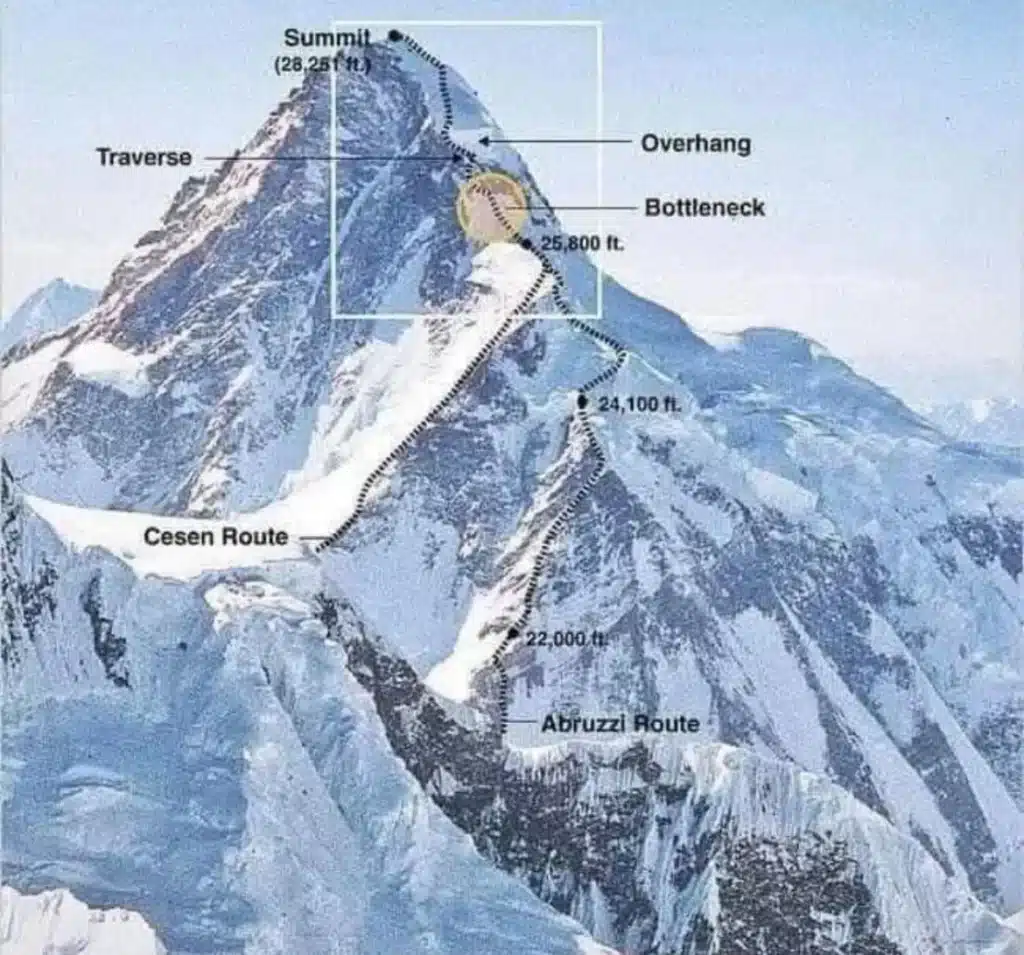
The K2 Bottleneck is a narrow, steep couloir on the South-East Spur of K2.
It sits roughly 400 meters below the summit, at an altitude between 8,200 m and 8,400 m.For a full understanding of the mountain’s scale, see our guide on K2 height in meters.
Every climber attempting K2 via the standard Abruzzi route must pass through it. For a full picture of K2’s routes and difficulty, read our ultimate K2 guide.
What does the Bottleneck look like?
The couloir is a compressed ice channel. It is roughly 50–60 degrees steep.
Above it hangs a massive serac, a towering block of glacial ice. This serac is unstable.
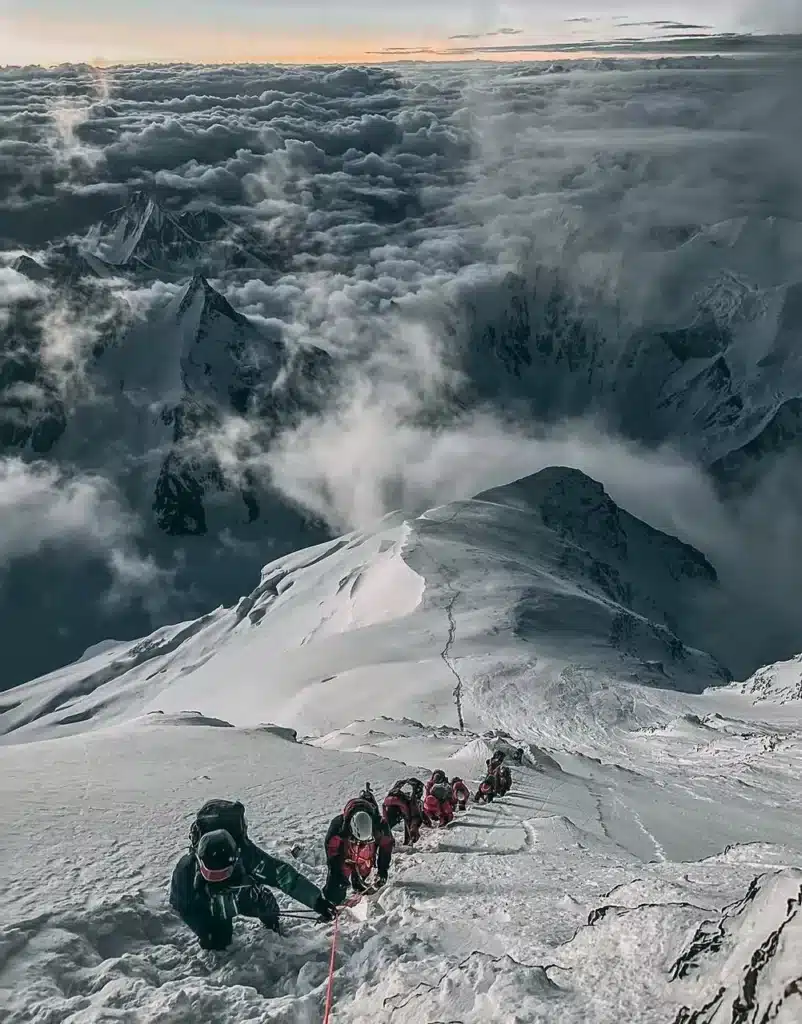
Climbers move in single file below the serac. Movement is slow. Exposure time is high.
Where exactly is the Bottleneck on K2?
It is located on K2’s South-South-East Spur, part of the Abruzzi Route.
K2 stands on the border of Pakistan and China in the Karakoram range.
The Bottleneck is the final technical obstacle before the summit snowfields.
K2 Bottleneck, Quick Facts
| Location | South-East Spur of K2, approximately 400 m below the summit |
| Altitude | ~8,200 m to 8,400 m (26,900 ft to 27,600 ft) |
| Gradient | 50–60 degrees near-vertical ice |
| Main hazard: | Serac collapse above the couloir triggering ice avalanche |
| Fatalities | 13 of the last 14 K2 deaths occurred at or near the Bottleneck |
| Deadliest event | 2008 disaster 11 climbers killed in a single expedition |
Why Is the K2 Bottleneck So Dangerous?
The Bottleneck combines three threats at once. Each is serious alone. Together, they are lethal.
1. The serac above the Bottleneck
A massive serac hangs directly above the couloir. It is not stable.
When it collapses, it sends ice and debris straight down the Bottleneck.
Climbers below have zero warning. They have no escape route.
In 2008, serac collapse destroyed fixed ropes and killed climbers descending at night.This event is covered in detail in our K2 summit records and statistics guide.
2. Extreme altitude, the death zone
The Bottleneck sits fully inside K2’s death zone, above 8,000 m.
At this altitude, oxygen availability drops by more than 65%.
Hypoxia impairs judgment, slows movement, and causes life-threatening decisions.
Climbers at the Bottleneck are already exhausted from 8,000 m+ of ascent.
3. Traffic jams at the Bottleneck
The couloir is narrow. Only one climber moves at a time on fixed ropes.
In peak season, K2 issues around 400 permits. Queues form at the Bottleneck.
Waiting in a queue at 8,300 m burns oxygen and body temperature rapidly.
Why does the Bottleneck have such a high fatality rate?
13 of the last 14 fatal accidents on K2 occurred at or near the Bottleneck. No other section of the mountain comes close to this statistic.
Most deaths happen on descent. Climbers are fatigued, oxygen-depleted, and sometimes descending in darkness.
K2’s overall fatality rate is around 25%. K2’s overall fatality rate is around 25%. To understand why this rate is so high, read our guide on how dangerous is K2. Our K2 mountain climb guide covers success rates, costs, and what separates summit attempts that work from those that don’t.
The 2008 K2 Bottleneck Disaster
What happened at the K2 Bottleneck in 2008?
On August 1–2, 2008, eleven climbers died on K2. It was the mountain’s worst single-season disaster.
Multiple teams were attempting the summit. They converged at the Bottleneck in a dangerous queue.
Serac collapse struck above the couloir. Falling ice severed fixed ropes on the descent route.
Climbers returning from the summit found their ropes gone. They were stranded at 8,300 m in darkness.
Some fell, Some froze, Some died waiting for rescue that could not reach them.
Why did so many die in 2008?
- Summit push was too late in the day , teams were descending at night
- Multiple nationalities with poor team coordination delayed movement
- Fixed ropes were destroyed by the serac collapse no safe descent line
- Climbers were already at the limit of physical capacity at 8,300 m
- Rescue at 8,000 m+ is nearly impossible, no helicopter can operate at that altitude
The 2008 disaster permanently changed how expedition teams plan K2 summit attempts.
K2 Bottleneck Altitude and Technical Details
What altitude is the K2 Bottleneck?
The Bottleneck traverse begins at approximately 8,200 m (26,900 ft).
The traverse above the Bottleneck extends to roughly 8,300–8,400 m (27,200–27,600 ft).
The summit of K2 is 8,611 m (28,251 ft). The Bottleneck is 200–400 m below the top.
What is the Bottleneck traverse?
After ascending the couloir, climbers make a leftward traverse across steep ice.
This traverse leads to the upper snowfields below the summit.
The traverse sits directly beneath the serac overhang. Exposure time here is critical.
Speed is mandatory. Slower teams increase their time under the serac threat.
What are the technical demands of the K2 Bottleneck route?
- Ice climbing skills at 50–60 degree gradient mandatory
- Jumar ascenders for fixed rope movement in crampons
- Ability to clip and unclip from fixed lines while wearing thick gloves
- Navigation under headlamp most teams pass the Bottleneck before dawn
- Physical output at extreme altitude with hypoxia already affecting the body
K2 Bottleneck Bodies and Deaths
Are there bodies in the K2 Bottleneck?
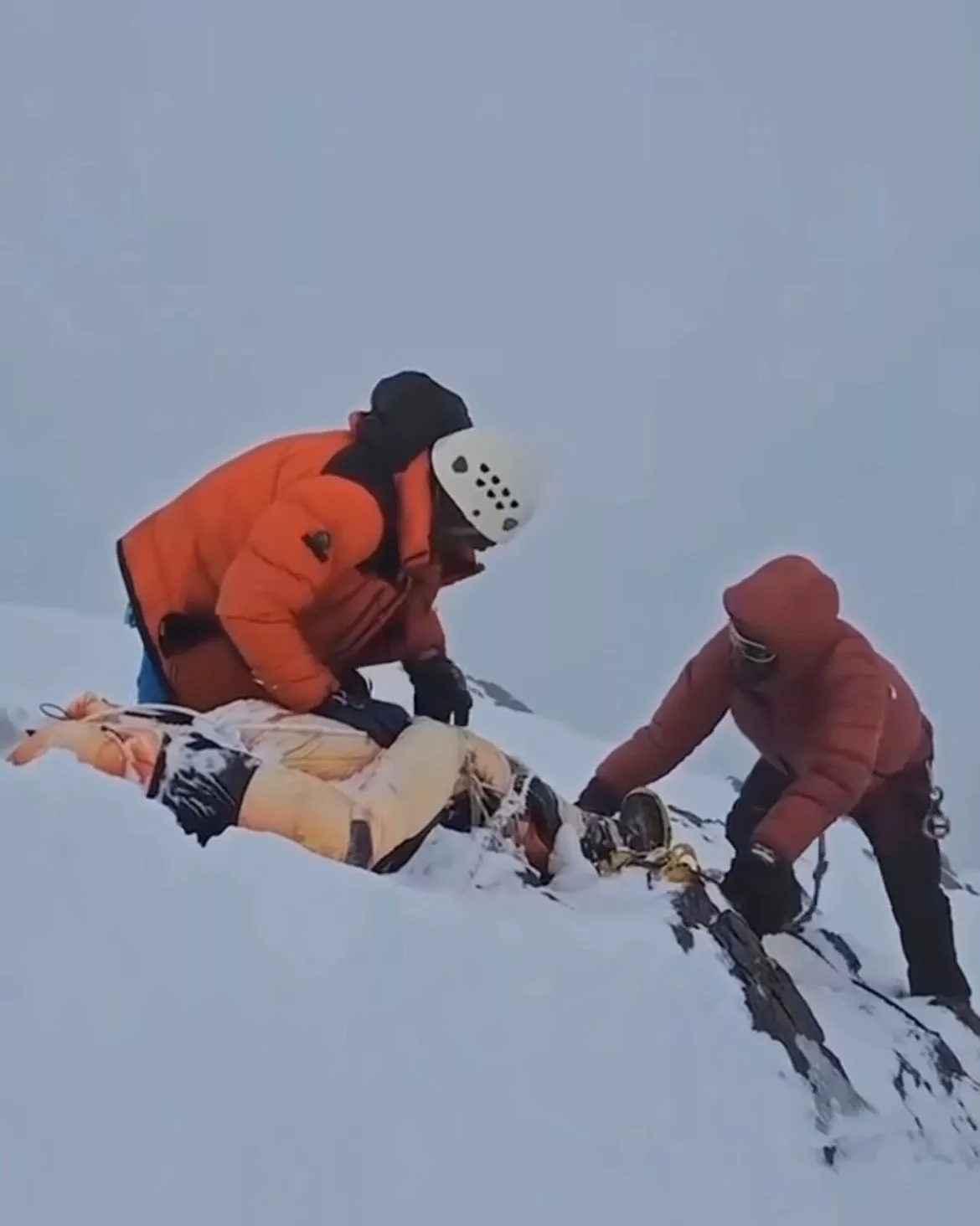
Yes. Several climbers who died in the Bottleneck area remain on the mountain.
Recovery of bodies at 8,200–8,400 m is extremely rare. The conditions make retrieval nearly impossible.
Some bodies have been pushed off the route by subsequent teams or covered by snowfall.

How many deaths have occurred at the K2 Bottleneck?
The Bottleneck accounts for the majority of K2’s total fatalities.
K2’s overall fatality rate is approximately 25% , roughly one death for every four successful summits.
Historical records show the serac zone, couloir, and traverse as the deadliest 400-meter stretch in mountaineering.
What is the K2 Bottleneck serac collapse risk today?
The serac above the Bottleneck is continuously shifting. It cannot be predicted.
Glacial ice in the Karakoram is subject to warming-related instability.
Modern expeditions still rate the serac collapse risk as the single greatest threat on the mountain.
There is no technical solution. The only answer is speed , minimize time below the serac.
How Do Climbers Navigate the K2 Bottleneck?
What is the standard protocol for the K2 Bottleneck?
- Summit push starts at Camp 4 between 20:00 and 23:00
- Teams arrive at the Bottleneck between 01:00 and 04:00 in darkness
- Fixed ropes are pre-installed by lead teams using ice screws and snow pickets
- Climbers ascend single file using jumar devices on the fixed line
- The traverse above is crossed as quickly as possible
- Summit window target: reach summit by 14:00 at the latest
- Teams descending after 15:00 face darkness in the Bottleneck high risk
What gear is required for the K2 Bottleneck?
- Double or triple-layer boots rated to -40°C
- 12-point crampons mandatory for 50–60 degree ice
- Jumar ascenders for fixed rope movement
- UIAA-certified helmet for serac icefall protection
- Supplemental oxygen reduces hypoxia-related decision errors
- Personal safety tether — for clipping anchors during rest
- Satellite communication device no cell signal at 8,200 m
Can you bypass the K2 Bottleneck?
No. The Bottleneck is on the only viable route to the K2 summit via the Abruzzi Spur.
The north ridge from China offers an alternative. However, it is technically harder and rarely used.
For all practical purposes, every K2 summiteer passes through the Bottleneck. See our detailed K2 climbing routes and cost guide for a full route comparison.
K2 Bottleneck vs Everest: How Do the Dangers Compare?
Is the K2 Bottleneck more dangerous than Everest’s Hillary Step?
Yes ,by a significant margin.
The Hillary Step on Everest is a technical rock section near the summit. It has overhead protection.
The K2 Bottleneck is a steep ice couloir below an active, collapsing serac with no shelter.
Everest’s summit death rate is approximately 1%. K2’s is approximately 25%. The Bottleneck is the primary reason for this difference. For a detailed comparison, see our guide on K2 vs Everest.
Preparing for the K2 Bottleneck: Training and Acclimatization
What training do climbers do for the K2 Bottleneck?
No untrained climber should attempt K2. The Bottleneck demands elite-level mountaineering.
- Ice climbing proficiency on 50–70 degree slopes required
- Previous 8,000 m summits strongly recommended as prerequisite
- Multi-month cardiovascular base high-altitude aerobic capacity
- Technical alpine routes Denali, Aconcagua, Broad Peak as progression
- Team communication drills critical for multi-national expeditions
Want to Experience K2 Without Climbing the Bottleneck?
Experience the legendary Karakoram on our guided K2 Base Camp Trek. Reach 5,150 m with experienced local guides, without attempting the technical K2 summit route.
What is the acclimatization schedule for K2?
Climbers typically spend 6–8 weeks at base camp before a summit attempt.
Rotations to Camp 1, 2, and 3 build altitude tolerance progressively.
The body needs time to increase red blood cell production above 5,000 m.
A rushed acclimatization schedule leads to poor performance in the Bottleneck. If you want to experience K2 without attempting the summit, our K2 Base Camp trek takes you to 5,150 m with full guide support the closest non-technical route to the mountain.
| Planning a trip to K2? Our guided K2 Base Camp Trek Pakages runs every season with certified high-altitude guides from Skardu. |
What Makes the K2 Bottleneck Unique?
The K2 Bottleneck is unique because it combines four simultaneous threats: extreme gradient, serac overhang, death-zone altitude, and no alternative route.
Every K2 climber faces it. There is no shortcut.
The 2008 disaster revealed the full extent of the Bottleneck’s danger. It changed expedition planning globally.
Modern teams move faster, start earlier, and carry more oxygen. But the serac above remains.
The Bottleneck does not reward bravery. It rewards preparation, speed, and the discipline to turn back when conditions are wrong.




Comments are closed