


K2 Mountain Climb Guide: Ultimate Routes, Cost & Success Rate
K2 is the world’s second-highest mountain, standing at 8,611 meters (28,251 feet) in the Karakoram Range of Gilgit-Baltistan, Pakistan. Also known as Mount Godwin-Austen and Chogori, it was first climbed on July 31, 1954 by Italian mountaineers Lino Lacedelli and Achille Compagnoli via the Abruzzi Spur.
K2 is widely considered the most technically challenging mountain on Earth to climb. Unlike Everest , which can be climbed by well-funded amateurs with enough time and supplemental oxygen ,K2 demands genuine mountaineering skill at every altitude. Its historical summit success rate is approximately 30%, compared to over 65% on Everest. One in every ten climbers who reach high on K2 does not come home.

This K2 Mountain Climb Guide covers everything a serious climber or k2 expedition planner needs to know: the mountain’s geography, its main routes, what makes the Bottleneck so dangerous, how long an expedition takes, what it costs, and the verified statistics on fatality and success rates.
Is K2 the Hardest Mountain to Climb?
K2 is widely considered the most technically difficult 8,000-meter mountain to climb. The answer is yes , but with an important distinction. Difficulty on high mountains has two components: technical skill required, and objective danger from uncontrollable events. K2 leads on the first. Annapurna I historically led on the second.
The technical case for K2
Unlike Everest, which contains the relatively flat Western Cwm where climbers can rest and recover psychologically, K2 maintains a sustained slope of 45 to 80 degrees from the moment a climber leaves Advanced Base Camp. This relentless steepness requires constant technical movement ,fixed ropes, crampons, and ice axes , without interruption. The sustained gradient leads to rapid physical and cognitive degradation at altitude.
The mountain’s route systems require V1 to V3 rock climbing moves and WI3 to WI4 ice climbing at altitudes where the available oxygen is roughly 40% of sea-level. No other 8,000-meter peak combines this grade of technical climbing with this altitude for this sustained a duration.
What Are the Main Routes on K2?
K2 has at least eight distinct climbing routes.
| Routes | First Ascent | Nationality |
| Abruzzi Spur (SE Ridge) | 1954 | Italian |
| Cesen Route (SSE Spur) | 1994 | Basque |
| Polish Line (S Face / Central Rib) | 1986 | Polish |
| Magic Line (SW Pillar) | 1986 | Polish-Slovak |
| Northeast Ridge | 1978 | American |
| West Ridge | 1981 | Japanese |
| North Ridge | 1982 | Japanese |
| NW Face | 1990 | Japanese |
1. The Abruzzi Spur (Southeast Ridge) the standard route
The Abruzzi Spur is chosen by approximately 75% of all K2 expeditions. Luigi Amedeo, Duke of the Abruzzi, first attempted it in 1909. The route was successfully summited 45 years later on July 31, 1954 by Lacedelli and Compagnoli the first humans to stand on K2.
The route follows a series of rock ribs and ice fields up the southeast ridge. Its most technical section is the Black Pyramid a 400-meter wall of mixed rock and ice that guards the route to the upper mountain. Below the Black Pyramid sits House’s Chimney, a vertical rock crack that requires genuine climbing skill at 6,400 meters.
Above the Black Pyramid, the route reaches the Shoulder at 7,800 meters. From here, climbers enter the Death Zone and face the final and most dangerous obstacle on the mountain: the Bottleneck.
2. The Cesen Route (South-Southeast Spur)
Tomo Cesen soloed a line up this spur in 1986, though his claimed summit remains debated. The route was officially confirmed by a Basque team in 1994. It is steeper and more direct than the Abruzzi Spur, bypassing House’s Chimney and the Black Pyramid. Both routes converge at the Shoulder at 7,800 meters before joining the final push through the Bottleneck.
3. The Polish Line (South Face / Central Rib)
Jerzy Kukuczka and Tadeusz Piotrowski established the Polish Line on the South Face in 1986. It is the most dangerous established route on K2. The route traverses the Hockey Stick gully, a steep couloir continuously threatened by falling ice and avalanche release from above.
The Polish Line has never been repeated. The combination of sustained objective hazard and extreme technical difficulty makes it, in many experienced alpinists’ view, the most committing line on any 8,000-meter peak.
4. The Magic Line (Southwest Pillar)
The Magic Line on the Southwest Pillar was first climbed in 1986 by a Polish-Slovak team. It is considered the second most difficult route on K2 in terms of sustained technical grade. Only two expeditions have ever successfully summited via the Magic Line: the 1986 first ascent team and Jordi Corominas in 2004.
The name Magic Line comes from its appearance on the mountain’s profile: a thin, improbable line that looks almost impossible to climb at altitude. It delivers on that reputation.
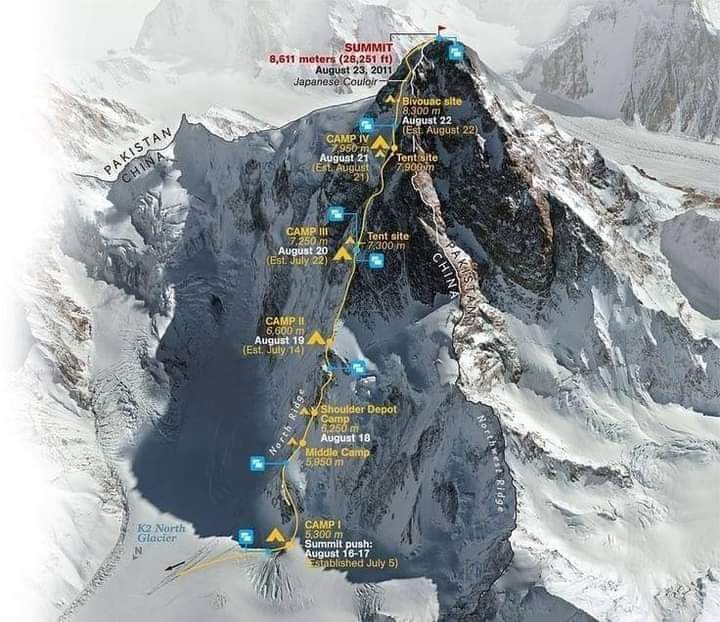
5. The North Ridge the Chinese side
The North Ridge is accessed from the Chinese side of the mountain, requiring crossing the Shaksgam River. It remains restricted to small elite teams because of the logistical complexity of Chinese permits and the complete absence of commercial support infrastructure. The route is a long, technically severe line rarely attempted.
What Is the Bottleneck on K2?
The Bottleneck is a narrow, 100-meter-long couloir located at approximately 8,200 meters on the Abruzzi Spur. It is the single most dangerous section of K2 and the site of the worst mountaineering disaster in the mountain’s history.

Its danger comes from position, not technical difficulty. The Bottleneck sits directly below a massive hanging glacier a serac that towers roughly 100 meters above the climbing line. Climbers are forced to traverse left across 50-degree ice slopes while exposed to potential serac collapse for several hours. In the Death Zone, physical speed is not possible. Every second spent under the serac is exposure to a hazard no amount of skill can prevent.
The 2008 disaster
On August 1, 2008, 11 climbers from multiple international teams died in and above the Bottleneck. A massive section of the serac released, killing climbers directly in its path and critically severing the fixed ropes required for descent. Teams that had successfully reached the summit could not get back down. The event killed more climbers in a single day than any other disaster in K2’s history.
The 2008 disaster also exposed a systemic problem: the traffic jam. Multiple commercial teams attempting the summit simultaneously are forced to queue through the single viable line at the Bottleneck. At 8,200 meters in the Death Zone, waiting in a queue is itself a lethal activity. For historical context, see our K2 summit records and statistics guide.
| KEY DANGER: The Bottleneck is located at 8,200 meters on a 50-degree traverse directly beneath a serac. Climbers spend 2-4 hours exposed to potential serac collapse in a zone where neither speed nor evasion is physically possible. There is no safe way through only a faster way. |
How Long Does It Take to Climb K2?
A complete K2 expedition requires a minimum of 55 to 70 days from Islamabad to summit and back. This is not conservative planning it is the biological minimum for safe altitude adaptation. Attempts to compress this timeline significantly increase the risk of HACE (High Altitude Cerebral Edema) and HAPE (High Altitude Pulmonary Edema), both of which can kill within hours.
The approach trek from Askole to K2 Base Camp follows the Baltoro Glacier for approximately 100 kilometres, passing through the established campsites of Paiyu, Urdukas, and Concordia. This 10-day walk is itself a significant undertaking at progressively higher altitude the same route used by K2 Base Camp trekkers, but at the start of an expedition rather than as the destination.
Want to Experience K2 Without Climbing It?
Trek across the Baltoro Glacier to Concordia and K2 Base Camp with experienced local guides.
Discover the K2 Base Camp Trek →What Is K2’s Summit Success Rate?
K2’s historical summit success rate is approximately 30% of all serious attempts. This compares to over 65% on Everest. The 30% figure reflects genuine technical difficulty not just commercial management differences between the two mountains.

The 2022 statistical pivot
The 2022 season changed K2’s statistical record permanently. A rare, sustained weather window allowed over 200 people to summit K2 in a single season more than the total summits recorded across many entire prior decades combined. This was not a coincidence.
Seven Summits Treks and other Nepali commercial firms applied the Everest model to K2: heavy rope-fixing on the Abruzzi Spur by elite Sherpa teams before commercial clients arrived, combined with large quantities of supplemental oxygen. The result was a temporary but dramatic shift in both the success rate and the fatality-to-summit ratio.
The current fatality-to-summit ratio stands at approximately 10.48:1 meaning one climber dies for every 10.48 summits. This is a genuine improvement. But the mountain’s objective hazards are completely unchanged. The seracs above the Bottleneck are the same. The sustained 45-80 degree slopes are the same. The weather patterns are the same.
The reduction in the death rate reflects significant advances in weather forecasting technology. In addition, a larger pool of experienced support staff is now available to assist struggling climbers, while commercial clients arrive with improved pre-expedition conditioning. However, this decline in fatalities does not mean that K2 has become easier.For a full analysis, see our guide on how dangerous is K2.
How Much Does It Cost to Climb K2?
A full K2 expedition costs $10,000–$25,000+ per person depending on operator, style (alpine vs expedition), and services included. Pakistan requires an official permit (~$4,000 per team member).
Our expedition cost and itinerary are strategically designed to remain competitive while maintaining the highest operational standards. check it out K2 Expedition 2025-26
Hiring a Professional Guide for K2 Expeditions
Licensed expedition operators offer comprehensive K2 expedition support, operating primarily from Islamabad. In addition to permit processing, these services include coordination with government-assigned liaison officers, base camp setup and management, and high-altitude porter (HAP) support. Furthermore, operators handle equipment transportation to base camp, implement structured acclimatisation plans, and oversee end-to-end logistics. As a result, climbers receive full operational support throughout the 55–70 day expedition timeline.For visa and permit details, see our Pakistan Trekking Visa guide.
High-Altitude Porters vs. Sherpas the modern reality
The modern K2 landscape involves a complex interaction between local Balti High-Altitude Porters (HAPs) and Nepali Sherpas. Balti HAPs come primarily from the Sadpara and Shimshal villages of Gilgit-Baltistan. They have an intimate knowledge of the Baltoro Glacier approach and have managed base camp logistics on K2 for generations.
In recent years, Nepali Sherpa teams from firms like Seven Summits Treks have dominated the technical rope-fixing and summit-day commercial guiding on the Abruzzi Spur. Local Pakistani HAPs typically manage the critical logistics of carrying gear to Base Camp and up to Camp 2. The two groups increasingly work alongside each other on large commercial expeditions.
Winter Mountaineering: The 2021 First Winter Ascent
K2 was the last of the fourteen 8,000-meter peaks to be climbed in winter. For decades, every winter attempt failed. The mountain’s extreme cold, violent jet stream winds, and physiological impossibility at that latitude made it the final frontier of Himalayan mountaineering.
What actually happened on January 16, 2021
On January 16, 2021, a team of 10 Nepali climbers reached the summit at 4:58 PM local time. Of the ten, only Nirmal Purja completed the ascent without bottled oxygen. The other nine members including Mingma G and Sona Sherpa used supplemental oxygen to ensure the success of the collective mission and the safety of all team members.
The team demonstrated extraordinary unity by waiting 10 metres below the summit so that all ten could step onto the peak together. They sang the Nepali national anthem on the summit of K2 in winter a moment that has entered the history of mountaineering.
Winter conditions on K2 are physiologically extreme. Temperatures regularly drop to -65 degrees Celsius. The low barometric pressure at K2’s latitude of 35 degrees North means the effective oxygen availability at the summit is significantly lower in winter than on Everest in spring a factor that had defeated every previous winter attempt for over three decades.
Conclusion: What K2 Demands of Every Climber
K2 is not the highest mountain on Earth, but it is the most demanding. Its combination of sustained technical difficulty, objective serac hazard, severe weather, and remote location creates a challenge that cannot be solved by commercial infrastructure alone. Every improvement in success rates since 2022 reflects better support systems not a simpler mountain.
The Bottleneck will always sit beneath that serac. The Polish Line will always be too dangerous to repeat. The 27% of climbers who die on the descent will always be a reminder that reaching the summit is only half the equation.
For those planning an expedition to K2 Base Camp rather than the summit, the Baltoro Glacier approach remains one of the finest mountain journeys on the planet completely accessible to fit, experienced trekkers with a licensed guide, without any of the extreme technical demands of the climbing routes described in this guide.
See K2 Up Close
Follow the legendary Baltoro Glacier route to Concordia and stand beneath K2 at Base Camp.
Frequently Asked Questions About Climbing K2
Q: Has anyone climbed K2 in winter?
A: Yes. On January 16, 2021, a team of 10 Nepali climbers made the first-ever successful winter ascent of K2. Nirmal Purja summited without supplemental oxygen. The other nine members used bottled oxygen. No other team has completed a winter ascent of K2 before or since.
Q: What oxygen do K2 climbers use?
A: Most modern commercial expeditions use supplemental oxygen from approximately Camp 3 (7,300m) upward. The standard flow rate during the summit push is 4 litres per minute. A typical climber uses 5 to 6 bottles on the upper mountain. Some elite alpinists attempt K2 without oxygen, but this requires exceptional pre-expedition high-altitude conditioning.
Q: Is K2 harder than Annapurna?
A: Statistically, Annapurna I has a higher historical fatality rate approximately 32-38% all-time versus K2’s 23-25%. But K2’s technical difficulty is rated higher among experienced alpinists. The distinction matters: K2 demands continuous technical climbing skill; Annapurna’s primary danger comes from massive, unpredictable avalanches that no skill can prevent.
Q: Can you see K2 from Skardu?
A: No. K2 is not visible from Skardu. The mountain is located deep inside the Karakoram, requiring an 80-kilometre glacier approach from Askole. The nearest point from which K2 becomes visible is Concordia (4,690m) on the Baltoro Glacier , approximately 15 kilometres from the mountain.
Q: What is the K2 death zone?
A: The Death Zone on K2 begins at 8,000 metres. Above this altitude, the human body consumes oxygen faster than it can absorb it from the thin air, regardless of fitness level. Prolonged exposure above 8,000m causes irreversible cellular damage. Most deaths on K2 occur in the Death Zone between the Shoulder at 7,800m and the summit at 8,611m.
Q: Who first climbed K2?
A: K2 was first summited on July 31, 1954 by Italian climbers Lino Lacedelli and Achille Compagnoli. They were members of an Italian expedition led by Ardito Desio. The ascent came via the Abruzzi Spur , the same route used by approximately 75% of all K2 expeditions today. The first ascent came 11 years after Everest’s first ascent in 1953.
Q: What is the Abruzzi Spur?
A: The Abruzzi Spur is the Southeast Ridge of K2 and the most commonly used climbing route ,chosen by approximately 75% of all expeditions. First attempted in 1909 by Luigi Amedeo, Duke of the Abruzzi. Key technical sections include House’s Chimney (6,400m), the Black Pyramid (a 400m mixed rock and ice wall), and the Bottleneck couloir (8,200m).
Explore our related K2 climbing guides and expedition resources for more detailed route analysis and climbing insights.




Comments are closed