


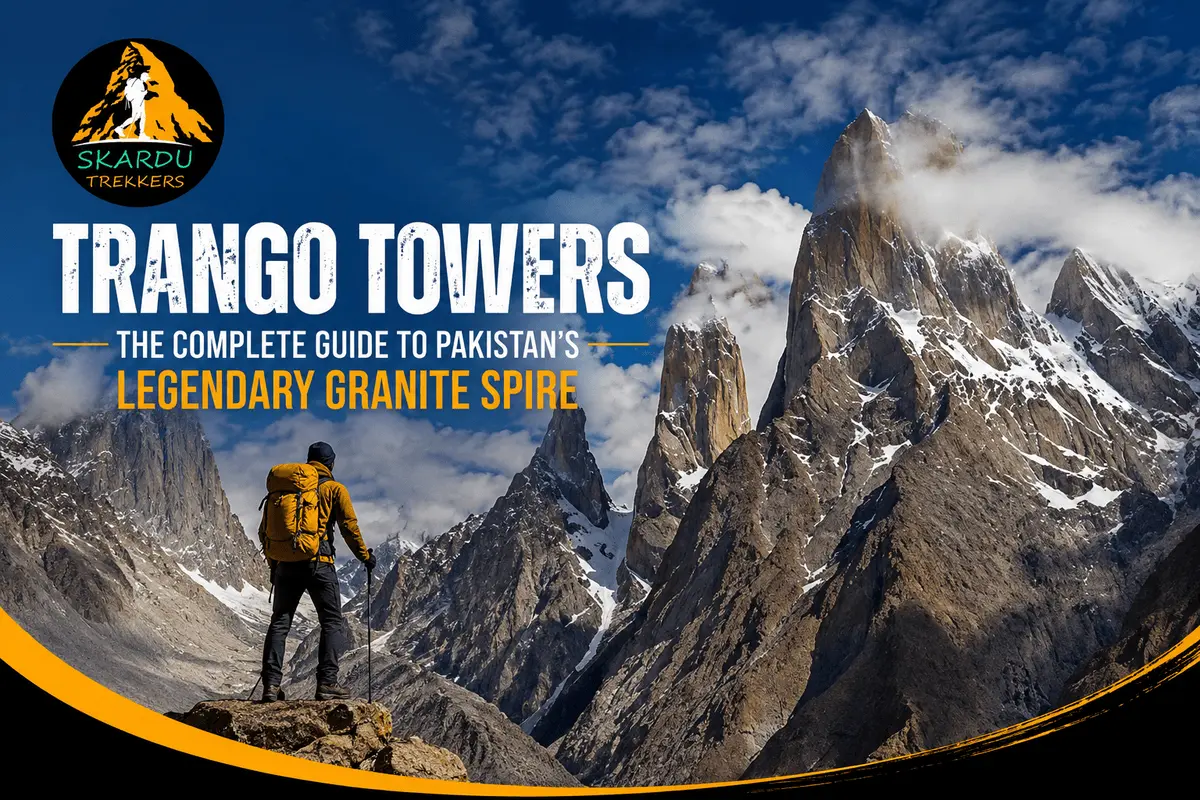
Trango Tower: The Complete Guide to Pakistan’s Legendary Granite Spire
Few mountains have earned the reputation Trango Tower has. It has drawn the world’s best big-wall climbers since the 1970s, hosted some of climbing’s most famous and most tragic first ascents, and become one of the most photographed granite spires on Earth. This guide covers everything about it: where it is, what makes it dangerous, its full climbing history, every major route, and what it takes to see it in person.
If you’re planning to stand at its base, our Trango Tower Expedition is a 35–40 day guided climb that takes you there. Everything below is the background every climber should know first.
Quick Facts: Trango Tower at a Glance
| Location | Karakoram Range, Gilgit-Baltistan, Pakistan |
| Great Trango Tower height | 6,286m (Main Summit); East Summit 6,231m; West Summit 6,223m |
| Nameless Tower height | 6,239m |
| First ascent (Nameless Tower) | 1976, Joe Brown, Mo Anthoine, Martin Boysen, Malcolm Howells |
| First ascent (Great Trango) | 1977, Galen Rowell, John Roskelley, Kim Schmitz, Dennis Hennek, Jim Morrissey |
| Most famous route | Eternal Flame (Nameless Tower), established 1989 |
| Base camp elevation | ~4,000m, on the Trango or Dunge Glacier |
| Best season | June to September |
| Nearest town | Askole, via Skardu |
What Is Trango Tower? Great Trango vs. Nameless Tower
“Trango Tower” causes more confusion than almost any other name in Himalayan climbing, because it’s used two different ways.
Nameless Tower (6,239m) is the sharp, single-summit spire most people picture when they hear “Trango Tower.” It juts roughly 1,000m straight up from the ridgeline in one continuous granite blade, and it’s the peak that carries the famous Eternal Flame route. In everyday climbing language, “Trango Tower” and “Nameless Tower” refer to the same mountain.
Great Trango Tower (6,286m) is a separate, taller massif next door, with four distinct summits Main, East, South, and West. It’s home to the longest routes in the group, including the 1,340m East Face, one of the largest continuous vertical rock faces on the planet.
Both towers sit within the same Trango group, rising out of the same glacier system, and climbers commonly refer to the whole group loosely as “the Trango Towers.” If you see conflicting numbers online for “Trango Tower’s height,” it’s almost always because one source means Nameless Tower and another means Great Trango.
Where Does the Name “Trango” Come From?
Even the name’s origin is disputed. One account, from a Balti cook on an expedition led by climber Greg Child, traces it to a local word, Tengos, once associated with a bottle of hair oil. Like much of the toponymy in this part of the Karakoram, place names shifted over decades as explorers, mapmakers, and local communities used different terms for the same features formal standardization didn’t arrive until the Royal Geographical Society’s Karakoram naming committee in 1937.
Where Is Trango Tower? Geography and Access
Trango Tower sits in the Baltoro Glacier region of the Karakoram Range, in Gilgit-Baltistan, northern Pakistan, at roughly 35°45′N, 76°12′E. It rises from the Baltoro-Muztagh sub-range, in the same corridor as K2, Broad Peak, and the Gasherbrums.
Reaching it means flying or driving from Islamabad to Skardu, then a jeep ride along the Shigar Valley and Braldu River to Askole the last village before the wilderness begins. From there, it’s several days of trekking across glacial moraine and ice to reach base camp, typically set up around 4,000m on the Trango Glacier (for Nameless Tower) or the neighboring Dunge Glacier (for Great Trango’s East Face routes).
The area only opened to foreign climbers in 1975. Everything that follows in this guide happened in the fifty years since.
Nearby Towers
The Trango group isn’t alone in this valley. Uli Biaho Tower (6,109m) and Shipton Spire (5,852m) rise from the same granite corridor and share the same approach. Uli Biaho fell in 1979 to Americans John Roskelley, Kim Schmitz, Ron Kauk, and Bill Forrest, climbing 34 pitches alpine-style. Shipton Spire wasn’t fully climbed until 1997, when Mark Synnott and Jared Ogden completed the Ship of Fools route on its east face. Both are worth knowing, but it’s Trango Tower and Great Trango that have drawn the biggest names in climbing history, decade after decade.
The Complete Climbing History of Trango Tower
1976: The First Ascent of Nameless Tower
The first team to summit Nameless Tower was British: Joe Brown, Mo Anthoine, Martin Boysen, and Malcolm Howells. After a failed attempt the year before, they returned in 1976 and climbed the Southwest Face a line graded VI, 5.10, A2, over roughly 1,100m, with about 80% climbed free, extraordinary for the era. Anthoine and Boysen reached the summit on 8 July; Brown and Howells followed the next day in worsening weather. Writer Jim Curran and cameraman Tony Riley documented the expedition; Curran’s book, Trango: The Nameless Tower, remains the definitive account of the climb.
1977: Great Trango Tower’s First Summit
The following year, Galen Rowell, John Roskelley, Kim Schmitz, Dennis Hennek, and Jim Morrissey made the first ascent of Great Trango Tower, climbing the west side via ice ramps, gullies, and rock faces to the upper South Face. Their trip in was nearly derailed before it began rerouted flights and a four-day storm at base camp, a reminder that on Trango, the approach can test a team as much as the wall.
1984: Two First Ascents, One Tragedy
Great Trango saw two new routes open in the same year, on opposite faces. Andy Selters and Scott Woolums spent four days establishing the Northwest Face still considered the mountain’s least difficult line, though “least difficult” here still means roughly 1,200m of serious technical climbing.
On the East Face, Norwegian climbers Hans Christian Doseth and Finn Dæhli opened what’s now called the Norwegian Route (or Norwegian Buttress) a 5,000-foot line up one of the largest continuous vertical rock faces on Earth. They reached the East Summit for the first time, but both climbers died during the descent. The route wasn’t safely climbed and descended until 1992, and it saw its first full repeat only in 2008, when a team of four Norwegian climbers spent 27 days on the wall to honor the original line.
1987–1990: The Free-Climbing Era Begins
In 1987, a Yugoslav (now Slovenian) team Slavko Cankar, Franc Knez, and Bojan Srot opened a new line on Nameless Tower’s south-southeast face, now known as the Slovenian Route or Yugoslav Route.
Two years later, in 1989, four German climbers Kurt Albert, Wolfgang Güllich, Christoph Stiegler, and Milan Sykora established Eternal Flame, the route that would define this mountain’s reputation for the next four decades. We cover its full story below.
In 1990, French climber Catherine Destivelle became the first woman to summit here, free-climbing the Slovenian Route with American alpinist Jeff Lowe on 6 September, filmed by David Breashears. Destivelle was already regarded as one of the best climbers in the world, and the ascent remains a landmark in the mountain’s history.
1992: The Grand Voyage
Eight years after the tragedy on the East Face, John Middendorf and Xaver Bongard completed the first safe ascent and return from the East Summit. Their route, the Grand Voyage, climbed the 1,340m headwall over 18 days, alpine-style with minimal fixed ropes still the only other completed route up that face.
1995: Todd Skinner’s Free Ascent
American climber Todd Skinner led a team nicknamed his “Wyoming cowboys” including Steve Bechtel, Mike Lilygren, and Bobby Model to the first free ascent of Nameless Tower’s East Face, climbing all 34 pitches without aid. It remains one of the defining American ascents of the decade.
1999: Parallel Worlds
Alex Lowe, Mark Synnott, and Jared Ogden opened Parallel Worlds on Great Trango’s West Summit and the neighboring Pulpit, over a 28-day expedition through 3,000 feet of slabs to a 2,500-foot vertical wall. The team also relayed daily updates, photos, and video from the wall via satellite-connected computers one of the earliest big-wall climbs broadcast live online, years ahead of the practice becoming common.
2009–2025: Eternal Flame’s Free-Climbing Legacy
Full details in the section below but in short: Alexander and Thomas Huber freed the entire route in 2009; Edu Marín, then Barbara Zangerl and Jacopo Larcher, repeated it free in 2022; Stefano Ragazzo made the first rope-solo ascent in 2024; and in August 2025, an Indonesian team became the first Asian team to summit via the route, followed weeks later by a German team’s full free ascent.
Trango Tower Routes Explained
| Route | Tower/Face | First Ascent | Team | Notes |
| Southwest Face | Nameless Tower | 1976 | Brown, Anthoine, Boysen, Howells | VI 5.10 A2, ~1,100m |
| West Side | Great Trango, Main Summit | 1977 | Rowell, Roskelley, Schmitz, Hennek, Morrissey | Ice, gullies, rock to South Face |
| Northwest Face | Great Trango | 1984 | Selters, Woolums | ~1,200m, easiest line to the summit |
| Norwegian Route (East Face) | Great Trango, East Summit | 1984 | Doseth, Dæhli | 5,000ft; first ascensionists died on descent |
| Slovenian/Yugoslav Route | Nameless Tower | 1987 | Cankar, Knez, Srot | Freed by Destivelle & Lowe, 1990 |
| Eternal Flame | Nameless Tower | 1989 | Albert, Güllich, Stiegler, Sykora | 24 pitches, ~650m, freed 2009 |
| Grand Voyage | Great Trango, East Summit | 1992 | Middendorf, Bongard | 1,340m headwall, 18 days, alpine-style |
| East Face (free) | Nameless Tower | 1995 | Skinner and team | 34 pitches, first free ascent |
| Parallel Worlds | Great Trango, West Summit/Pulpit | 1999 | A. Lowe, Synnott, Ogden | 28-day push |
How Trango’s Routes Are Graded
Climbs here mix aid and free techniques on compact, high-quality granite from the Baltoro batholith. Classic alpine-style lines typically run VI to VI+, with significant aid sections (A3–A4) on the harder faces, interwoven with free climbing up to 5.11 or higher on cracks, dihedrals, and roofs. Since the 1990s, the trend across nearly every route on this list has moved toward freeing what was once aided the same story that plays out route by route above.
Eternal Flame: The World’s Most Famous Rock Climb
Eternal Flame is a roughly 650m, 24-pitch route up the south buttress of Nameless Tower, established in 1989 by Kurt Albert, Wolfgang Güllich, Christoph Stiegler, and Milan Sykora. Climbing at altitudes over 6,000m, the team completed about 80% of the route free, on clean orange granite splitter cracks, aiding only four pitches a remarkable standard for the time, and the achievement that made this the most sought-after high-altitude rock climb in the world.
It took 20 years before anyone climbed it completely free. Brothers Alexander and Thomas Huber finally did it in 2009, helped by an unusually long stretch of good weather on a route that had turned back some of the best climbers alive for two decades.
Since then, the route has kept drawing top climbers:
- 2022: Spanish climber Edu Marín completed the second free ascent on a 28-day solo push; Barbara Zangerl and Jacopo Larcher followed soon after, climbing all 24 pitches together without a single fall.
- 2024: Italian climber Stefano Ragazzo made the first rope-solo ascent.
- August 2025: A six-person Indonesian team from Big Wall Expedition (IBEX) became the first Asian team to summit Nameless Tower via Eternal Flame, completing a 28-day expedition despite pausing two days for a rockfall-injury rescue partway up the wall. Weeks later, a German team from Dresden Julius Brunner, Sebastian Gantz, Hanna Kallweit, and Rosa Windelband made a full team free ascent, with every pitch freed by at least one member.
Climber and writer Jim Curran’s book, Trango: The Nameless Tower, remains a key reference for the mountain’s early history, though it predates Eternal Flame’s establishment.
How Dangerous Is Trango Tower?
Trango Tower is a serious, high-risk objective, not suitable for anyone without real big-wall experience. The main hazards:
- Altitude sickness. Base camp sits around 4,000m, and summit pushes go well above that.
- Rockfall. Weathering along granite joints and fractures creates loose blocks on ledges and dihedrals, especially with freeze-thaw cycling.
- Sudden weather changes. The Karakoram is notorious for storms that build fast, even in the June–September climbing window.
- Technical difficulty. Steep granite, long multi-day pitches, and occasional ice sections test even highly skilled climbers.
- Rescue limits. Helicopter evacuation in this region can be grounded by wind, weather, or remoteness as seen in the 2025 Indonesian team’s rockfall injury, which required a ground-based vertical rescue rather than an air evacuation.
The clearest reminder of the risk is the 1984 East Face first ascent itself: Hans Christian Doseth and Finn Dæhli reached the East Summit but died during the descent — a route that took eight more years before anyone completed a full round trip.
Records in the Air: BASE Jumps and Ski Descents
Trango’s scale has attracted more than climbers. On 26 August 1992, Australians Nic Feteris and Glenn Singleman climbed Great Trango and then BASE jumped from high on the peak, landing on the Dunge Glacier at the time, the highest starting elevation ever recorded for a BASE jump. Andrey Lebedev and Vladimir Murzaev repeated the jump in 2013, and in 2023, Eric Jamet and Antoine Pecher repeated it again before climbing Eternal Flame and BASE jumping from the summit of Nameless Tower itself, a feat documented in a 26-minute film shown at the Banff film festival.
In May 2024, Chantel Astorga, Christina Lustenberger, and Jim Morrison completed the first ski descent of Great Trango’s main summit. On their second attempt in two years, after three and a half weeks acclimatizing, they climbed to a 5,000m high camp, then skied the same north-northwest line first climbed by Selters and Woolums in 1984, down a hanging glacier and narrow ice ridge back to the Trango Glacier.
Season, Permits, and Practical Planning
Best season: June through September, when Karakoram weather is most stable and daylight hours are longest for safe glacier travel. Outside this window, heavy snowfall and sub-zero conditions typically make the approach impassable.
Permits: Foreign climbers need a trekking and mountaineering permit arranged through a registered operator, plus a Pakistan Trekking and Mountaineering Visa not a standard tourist visa. Since Trango’s summits sit below the 6,500m threshold that triggers climbing royalty fees, no royalty applies, though a monthly trekking fee and a separate environmental/waste-management fee go toward conservation work in the Central Karakoram National Park.
Conservation: The Central Karakoram National Park and local Balti communities run active waste-collection efforts along the Baltoro corridor, an increasingly important issue as glacier retreat accelerates across the region. Expedition teams are generally expected to pack out everything they bring in.
Local support: Nearly every expedition here relies on Balti porters and guides from Skardu and the Shigar Valley, both for logistics and as a major source of local income tied to mountain tourism.
Frequently Asked Questions
Is Nameless Tower the same as Trango Tower?
Yes. “Trango Tower” and “Nameless Tower” refer to the same 6,239m spire. Great Trango Tower (6,286m) is a separate, taller peak in the same group.
How tall is Trango Tower?
Nameless Tower stands 6,239m. Great Trango Tower’s main summit reaches 6,286m, with its East and West summits at 6,231m and 6,223m.
Who made the first ascent of Trango Tower?
British climbers Joe Brown, Mo Anthoine, Martin Boysen, and Malcolm Howells summited Nameless Tower on 8–9 July 1976.
What is the Eternal Flame route?
A 24-pitch, roughly 650m route on Nameless Tower, first climbed in 1989 and widely considered one of the best big-wall rock climbs in the world.
Is Trango Tower dangerous to climb?
Yes, it’s an advanced objective with real risks from altitude, rockfall, sudden weather, and limited rescue access. It is not suitable for beginners.
What is the best time to climb Trango Tower?
June through September, when the Karakoram’s weather is most predictable.
How do you get to Trango Tower?
Fly or drive from Islamabad to Skardu, then jeep to Askole, followed by several days trekking across the Baltoro region to base camp.
Ready to See It Yourself?
Every climber in this history started from the same place our guests do: base camp on the Baltoro or Dunge Glacier, beneath the same granite that Brown, Rowell, Skinner, and the Huber brothers all climbed. Our Trango Tower Expedition is a 35–40 day guided trip built for climbers ready to take on this mountain’s legendary routes for themselves.
Contact us to start planning your Trango Tower expedition.




Comments are closed