


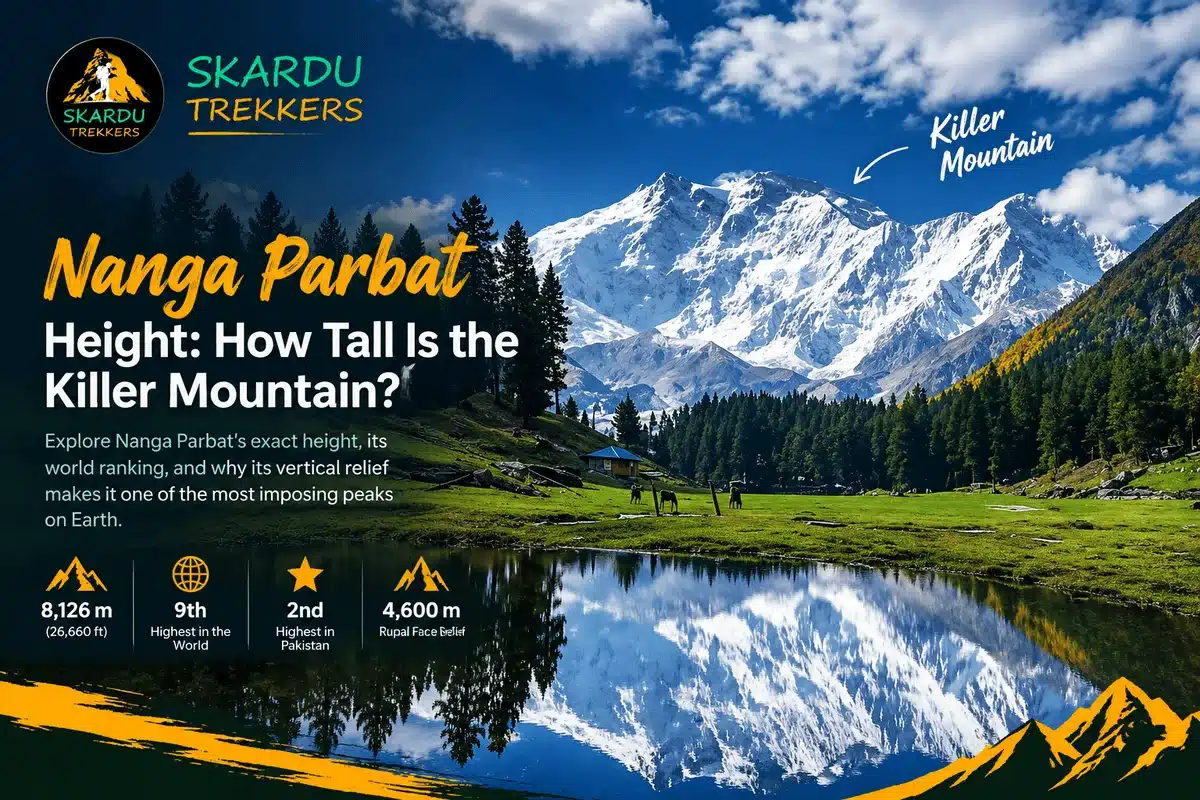
Nanga Parbat Height: How Tall Is the Killer Mountain?
Nanga Parbat is 8,126 metres (26,660 feet) tall, making it the ninth-highest mountain in the world and the second-highest in Pakistan after K2. It is one of only fourteen mountains on Earth that rise above 8,000 metres, a category known as the “eight-thousanders.” Located in the Diamer district of Gilgit-Baltistan, at the western edge of the Himalaya, Nanga Parbat is often called the “Killer Mountain” for its steep, technical routes but its raw height is only part of what makes it so imposing.
Below, you’ll find its exact height in both metres and feet, how that height compares to Everest and K2, and why the mountain’s sheer vertical relief makes it feel far bigger in person than its world ranking alone would suggest.
Quick Facts: Nanga Parbat’s Height
| Field | Value |
| Height (metres) | 8,126 m |
| Height (feet) | 26,660 ft |
| World rank | 9th highest |
| Pakistan rank | 2nd highest |
| Category | Eight-thousander (8000er) |
| Rupal Face relief | ~4,600 m base-to-summit |
How Tall Is Nanga Parbat in Metres and Feet?
Nanga Parbat stands at 8,126 metres, or 26,660 feet, above sea level. This figure comes from modern surveys and is the height most commonly cited by mountaineering bodies and reference sources today.
You may occasionally see the mountain listed at 8,125 m instead of 8,126 m. This one-metre discrepancy comes from slightly different historical survey datasets and rounding conventions rather than any real change in the mountain’s height both figures refer to the same summit, and the difference has no practical bearing on the mountain’s ranking or classification. For consistency, this guide uses 8,126 m (26,660 ft), the figure most widely adopted in current references.
World and Pakistan Ranking
Nanga Parbat is the ninth-highest mountain in the world and the second-highest peak in Pakistan, behind only K2. It belongs to an elite group of fourteen mountains on Earth known as the eight-thousanders peaks that exceed 8,000 metres in elevation, all of them located in the Himalaya and Karakoram ranges of Asia.
Unlike most of the other eight-thousanders, which cluster together in Nepal, Tibet, and the Karakoram, Nanga Parbat stands alone at the extreme western end of the Himalaya, separated from its nearest 8,000m neighbors by hundreds of kilometres. This isolation is part of why the mountain dominates its local skyline so completely there’s nothing else nearby to rival its scale.
Nanga Parbat’s ranking also extends beyond simple elevation. By topographic prominence a separate measure that captures how independently a peak rises rather than how tall it is above sea level Nanga Parbat ranks among the top fifteen mountains in the world, a reflection of just how dramatically it rises from its surrounding valleys compared to peaks that sit within a connected range of similarly high neighbors.
How Does Nanga Parbat Compare? (Everest, K2, and Others)
Height alone puts Nanga Parbat well below the two most famous eight-thousanders, but the gap in metres doesn’t tell the full story of how each mountain is experienced by climbers.
| Mountain | Height | World Rank |
| Mount Everest | 8,849 m (29,032 ft) | 1st |
| K2 | 8,611 m (28,251 ft) | 2nd |
| Nanga Parbat | 8,126 m (26,660 ft) | 9th |
Nanga Parbat is shorter than both Everest and K2 by 723 metres and 485 metres respectively yet it’s frequently ranked among the most dangerous mountains to climb, historically carrying one of the highest fatality rates of any eight-thousander. If you’re curious how it stacks up against Pakistan’s tallest peak in more detail, see our full comparison of K2’s height and ranking.
Put another way, Nanga Parbat’s summit sits at roughly 92% of Everest’s height a smaller gap than the 485 m separating it from K2 might suggest. For context, the gap between Everest and K2 (1st and 2nd) is just 238 m, while the gap between K2 and Nanga Parbat (2nd and 9th) is more than double that. It’s one reason mountaineers tend to talk less about exact metres and more about route difficulty and exposure — factors where Nanga Parbat often outranks taller peaks entirely.
Why Nanga Parbat Feels Even Bigger Than Its Height
Summit elevation is measured from sea level, but it’s vertical relief the rise from a mountain’s base to its summit that determines how massive a peak actually feels to someone standing beneath it. This is the detail that makes Nanga Parbat exceptional.
The mountain’s south side, the Rupal Face, rises roughly 4,600 metres from base to summit, climbing in one continuous, unbroken wall from the Rupal Valley floor at around 3,500 m to the 8,126 m summit. It’s widely regarded as the tallest mountain face on Earth. For comparison, the entire vertical rise of many well-known peaks elsewhere in the world doesn’t come close to matching what Nanga Parbat’s south face alone achieves in a single, sustained sweep.
This is also why Nanga Parbat has one of the highest prominence values of any mountain on the planet a measure of how much a peak rises above the surrounding terrain rather than neighboring higher ground. Combined with the Rupal Face’s relief, it’s a major reason the mountain has such an outsized visual and psychological impact on climbers and trekkers who approach it, despite ranking only ninth in absolute height.
Nanga Parbat’s Three Faces
The Rupal Face is only one side of the mountain. Nanga Parbat presents three distinct faces: the Rupal Face to the south, the Diamir Face to the west, and the Rakhiot Face to the northeast. The Rakhiot side climbs roughly 7,000 m from the Indus River valley to the summit one of the greatest elevation gains anywhere on Earth, spread over a longer distance than the Rupal side’s sheer wall.
This three-sided massif shaped the mountain’s early climbing history, too. The Rupal Face saw its first ascent in 1970, when Reinhold and Günther Messner summited via the south side and descended the Diamir Face in an unplanned traverse a descent during which Günther was killed, cementing much of Nanga Parbat’s reputation as the “Killer Mountain.”
Quick Recap: Why the Numbers Matter
At 8,126 m (26,660 ft), Nanga Parbat is the ninth-highest mountain on Earth and Pakistan’s second-highest after K2 but its ranking by elevation alone undersells it. Between its ~4,600 m Rupal Face, its near-7,000 m rise on the Rakhiot side, and its outsized topographic prominence, Nanga Parbat delivers a scale of vertical relief that few, if any, mountains on the planet can match, regardless of where it lands on a simple height-ranked list.
FAQ
How tall is Nanga Parbat in feet?
26,660 feet (8,126 metres).
Is Nanga Parbat taller than K2?
No. K2 is 8,611 m; Nanga Parbat is 8,126 m. K2 is Pakistan’s highest mountain, and Nanga Parbat is its second-highest.
Is Nanga Parbat one of the eight-thousanders?
Yes, it is the ninth-highest of the fourteen mountains above 8,000 m.
Why does Nanga Parbat look so massive despite ranking ninth?
Its Rupal Face rises about 4,600 m from base to summit in one continuous wall, giving the mountain exceptional vertical relief and making it appear far larger than its height ranking alone suggests.





Comments are closed