


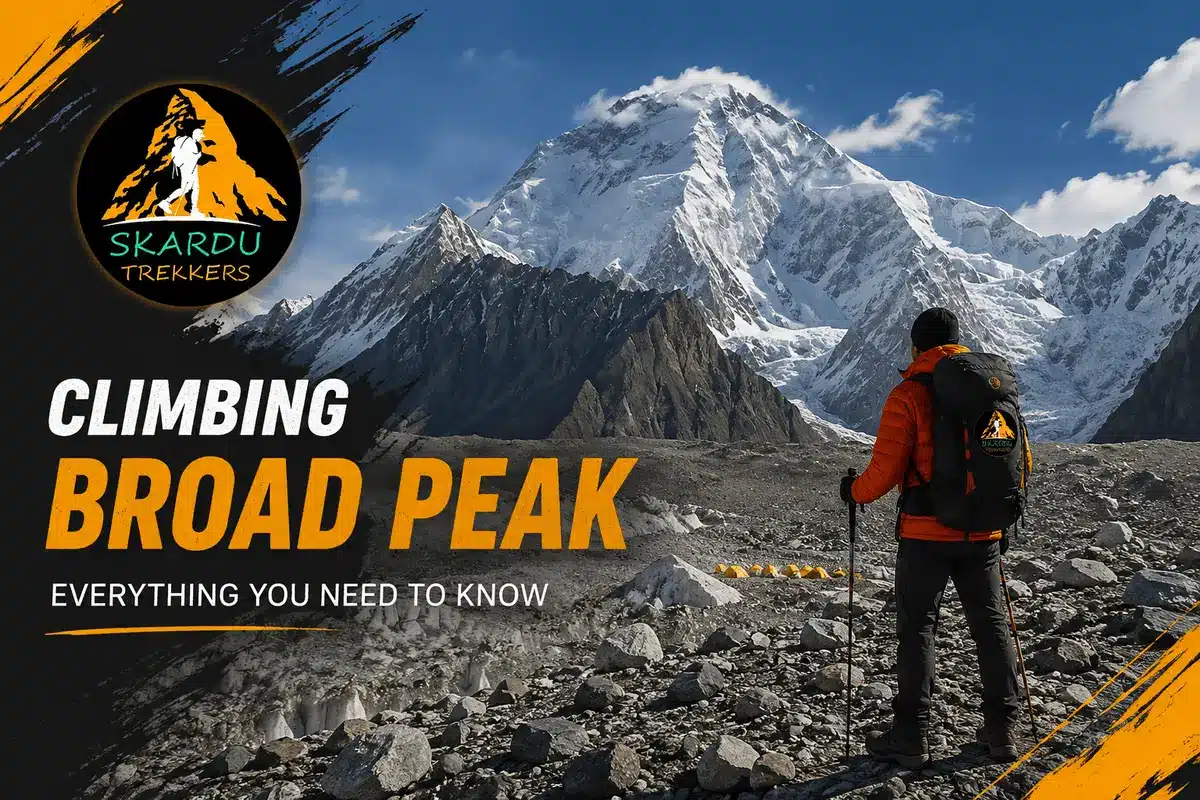
The Complete Guide to Climbing Broad Peak: Everything You Need to Know
Broad Peak is the 12th highest mountain in the world at 8,051 meters, rising in Pakistan’s Karakoram Range just 8km from K2. It’s often described as one of the more approachable of the world’s fourteen 8,000m peaks a common choice for climbers attempting their first eight-thousander. That reputation is only partly earned: Broad Peak’s standard route is less technical than K2’s, but its long, exposed summit ridge and the Karakoram’s unpredictable weather have made it the site of some of high-altitude mountaineering’s most sobering tragedies, including a catastrophic avalanche in 2026 that killed ten climbers.
This guide covers everything: location, height, climbing history, routes, difficulty, safety statistics, and what it takes to prepare for an expedition. If you’re ready to plan a climb, our Broad Peak Expedition follows the standard route described below.
Understanding Broad Peak: Location, Height & Geography
Where Is Broad Peak Mountain Located?
Broad Peak is located in the Karakoram Range, on the Pakistan-China border, in Gilgit-Baltistan. It’s part of the Gasherbrum massif and sits roughly 8km from K2, close enough that most expeditions to either peak share the same approach via the Baltoro Glacier and Concordia.
What Is the Height of Broad Peak?
Broad Peak stands 8,051 meters (26,414 feet) tall, making it the 12th highest mountain in the world. The mountain actually has three named summits Main (8,051m), Central (8,016m), and North (7,550m) plus a foresummit, which together give the mountain its unusually wide, roughly 1.5km summit ridge and its name.
Broad Peak vs. Other 8,000m Peaks
| Peak | Elevation | Global Rank | Notable Comparison |
| Mount Everest | 8,849m | 1st | ~800m taller than Broad Peak |
| K2 | 8,611m | 2nd | 8km from Broad Peak; far higher fatality rate |
| Broad Peak | 8,051m | 12th | One of the less technical 8,000m standard routes |
Broad Peak’s standard route is considered less technically demanding than K2’s Abruzzi Spur, which is part of why it’s often recommended as a first 8,000m objective. That comparison has limits, though “less technical than K2” still means a serious high-altitude climb, not an easy one.
History of Broad Peak Expeditions
Who Climbed Broad Peak First?
An Austrian expedition led by Marcus Schmuck made the first ascent on June 9, 1957. Schmuck, Hermann Buhl, Kurt Diemberger, and Fritz Wintersteller reached the summit climbing alpine-style, without supplemental oxygen or high-altitude porter support a remarkably bold approach for the era, and the first 8,000m peak ever climbed in that style. Buhl died weeks later in a fall on nearby Chogolisa.
Notable Broad Peak Expeditions
Broad Peak’s history includes several defining moments beyond the first ascent:
- 1975: A Polish team led by Janusz Ferenski made the first confirmed ascent of Broad Peak Central.
- 1988: Polish climber Maciej Berbeka, part of a team originally aiming for K2, was diverted to Broad Peak by bad weather. He climbed to what he believed was the summit only to learn later it was the Rocky Summit, roughly 23m lower than the true summit.
- 2013: Berbeka returned 25 years later as part of the first winter ascent of Broad Peak. He and teammate Tomasz Kowalski reached the true summit on March 5, 2013, but both died during the descent after failing to reach Camp 4.
- 2026: A massive avalanche swept ten climbers to their deaths, including record-holding Nepali mountaineer Nirmal “Nims” Purja the deadliest single incident in the mountain’s history. Full details below.
Climbing Broad Peak: Key Information
Is Broad Peak Easy to Climb?
No 8,000m peak is easy, and Broad Peak is no exception. It’s considered one of the more accessible eight-thousanders because its standard route involves less technical rock and ice climbing than K2 or Nanga Parbat, but success still depends heavily on proper acclimatization, physical fitness, weather timing, and prior high-altitude experience. The mountain’s long, exposed summit ridge, where several fatal incidents have occurred, is the clearest reminder that “accessible” doesn’t mean safe.
Broad Peak Climbing Routes
The standard route follows the West Spur (West Ridge), first climbed by the 1957 Austrian team and still used by the vast majority of expeditions today. From base camp on the Godwin-Austen Glacier, the route climbs through a series of camps up the west side of the mountain to a long, exposed summit ridge the same ridge crossed by every ascent from 1957 through the 2013 winter climb and beyond. Alternative lines exist, including approaches toward the Central and North summits, but these see far less traffic and carry additional route-finding and technical demands.
Broad Peak Difficulty & Technical Requirements
Broad Peak sits at an intermediate-to-advanced level of high-altitude mountaineering. Technical requirements include:
- Proficiency with an ice axe, crampons, harness, and fixed-rope ascending technique
- Comfort on mixed snow, ice, and rock terrain above 7,000m
- High-altitude endurance built from prior expeditions, ideally including at least one 6,000m+ summit
Physically, climbers need a strong cardiovascular base and the ability to function effectively at extreme altitude, where oxygen levels drop to roughly a third of sea-level pressure.
Broad Peak Success & Safety Statistics
Broad Peak Total Successful Summits
Precise lifetime summit counts vary by source, but by the early 2000s, climbing databases tracked around 255 ascents in the mountain’s first 46 years, a number that has grown substantially since as 8,000m mountaineering has become more accessible. Annual summit numbers have climbed from single digits in the mountain’s early decades to considerably higher figures in recent seasons, before the 2026 season’s tragedy interrupted that trend.
Broad Peak Fatality Rate
Historical tracking through the early 2000s put Broad Peak’s fatality rate at around 7%, based on roughly 255 ascents and 18 deaths comparable to, and in some analyses slightly lower than, Everest’s historical rate. More recent estimates from specialist outlets like ExplorersWeb have cited a rate closer to eight deaths per hundred successful summits. However you calculate it, these figures predate the 2026 avalanche, which added ten deaths in a single incident and will meaningfully raise the mountain’s lifetime fatality statistics once fully accounted for.
Broad Peak Deaths: Causes, Prevention, and the 2026 Avalanche
Fatalities on Broad Peak cluster into recognizable categories: avalanches, falls on the exposed summit ridge, altitude illness (HACE/HAPE), exhaustion, and disappearances in bad weather during descent. Most deaths occur on the way down, when climbers are physically depleted and the long ridge offers little margin for error.
The mountain’s worst single tragedy came in late July 2026, when an avalanche struck a group of climbers on the standard route, sweeping away ten people. Among the dead was Nirmal “Nims” Purja, the Nepali mountaineer famous for setting speed records across the world’s fourteen 8,000m peaks, along with American climber Mallory Geis, Omani climber Nadhira Al Harthy, Pakistani guide Sohail Sakhi, and several Nepali high-altitude guides, including Pur Bahadur “Yukta” Gurung, Nima Sherpa, Gyalu Sherpa, and Nawang Thindu Sherpa. The Alpine Club of Pakistan coordinated a multi-day recovery effort with Pakistani and Nepali high-altitude climbers, and nearby K2 expeditions suspended their own climbs to assist. It stands as the deadliest single incident in Broad Peak’s climbing history.
Prevention on Broad Peak centers on the same fundamentals that matter on any 8,000m peak: conservative weather-window judgment, strict turnaround times regardless of proximity to the summit, proper acclimatization rotations, and climbing with experienced, licensed guides who know the mountain’s specific hazard zones particularly the sections between camps where avalanche risk concentrates after storms.
Preparing for a Broad Peak Expedition
Broad Peak Expedition Cost
Costs for a Broad Peak expedition vary by season, team size, and support level, and typically include the government royalty and permit fee, a mandatory liaison officer, porters, base camp staff, and logistics from Islamabad through Skardu. Foreign and Pakistani national pricing structures differ. See our Broad Peak Expedition page for current package pricing.
Broad Peak Climbing Season & Weather
The best season to climb Broad Peak runs from June to August, aligning with the broader Karakoram climbing window. Even within this period, conditions can shift quickly cold, high winds, and sudden snowfall are common, and the mountain’s history shows that even well-timed expeditions can be caught by fast-moving weather or unstable snowpack, as the 2026 avalanche demonstrated.
Required Equipment for Broad Peak
A Broad Peak expedition requires full 8,000m mountaineering gear: crampons, an ice axe, a climbing harness, a mountaineering helmet, carabiners and ascending devices for fixed lines, high-altitude mountaineering boots, and an extreme-cold down suit or equivalent layering system for summit-day conditions. Personal clothing needs to handle temperature swings from relatively mild base camp days to extreme cold and wind on the upper mountain. Contact us for a full expedition gear checklist specific to your trip dates.
Broad Peak Expedition Itinerary Overview
Understanding the Broad Peak Trek
The journey to Broad Peak begins in Islamabad, with a flight or drive to Skardu, followed by a jeep ride to Askole and several days trekking the Baltoro Glacier toward Concordia the same approach shared by K2 and the Gasherbrum expeditions. From Concordia, teams continue to Broad Peak Base Camp on the Godwin-Austen Glacier, directly across from K2’s own base camp, giving climbers close-up views of the world’s second-highest mountain throughout the expedition.
Acclimatization Strategy
Broad Peak expeditions follow a structured rotation system: climbers move up to progressively higher camps, then descend to recover before pushing higher again, allowing the body to adapt gradually to reduced oxygen levels. This typically includes scheduled rest days at base camp and careful monitoring for early signs of altitude sickness, since ignoring symptoms in the early stages is one of the most preventable causes of serious incidents on the mountain.
Frequently Asked Questions About Broad Peak
Is Broad Peak hard to climb?
Broad Peak is considered one of the more accessible 8,000-meter peaks, but it still requires excellent fitness, technical mountaineering skills, and proper acclimatization. “Accessible” is relative to other eight-thousanders, not to climbing in general.
Can beginners climb Broad Peak?
While it’s often called a good “first 8,000m peak,” it is not a beginner climb. Prior experience on at least one 6,000m+ expedition is strongly recommended before attempting Broad Peak.
Is Broad Peak dangerous?
Yes. Like all 8,000m peaks, Broad Peak carries significant risk from avalanches, falls on its exposed summit ridge, and altitude illness. The July 2026 avalanche that killed ten climbers, including Nirmal Purja, is a stark recent reminder of that risk. Proper planning, conservative decision-making, and experienced guides help manage but never eliminate these dangers.
Do you need oxygen for Broad Peak?
Most climbers summit Broad Peak without supplemental oxygen, following the tradition set by the 1957 first-ascent team, though some choose to use it, particularly on guided commercial expeditions.
Does Broad Peak have a true story or movie?
Yes. Broad Peak (2022), directed by Leszek Dawid and released on Netflix, dramatizes the true story of Polish mountaineer Maciej Berbeka his near-summit in 1988 (when he unknowingly stopped at the lower Rocky Summit) and his return 25 years later for the first winter ascent in 2013, during which he and teammate Tomasz Kowalski died on the descent after reaching the true summit.
Book Your Broad Peak Expedition Today
Broad Peak remains one of the world’s great mountaineering objectives and, as recent events have shown, one that demands total respect. Ready to climb Broad Peak? Contact us for a quote, or visit our Broad Peak Expedition page for full itinerary and pricing details.



Comments are closed