


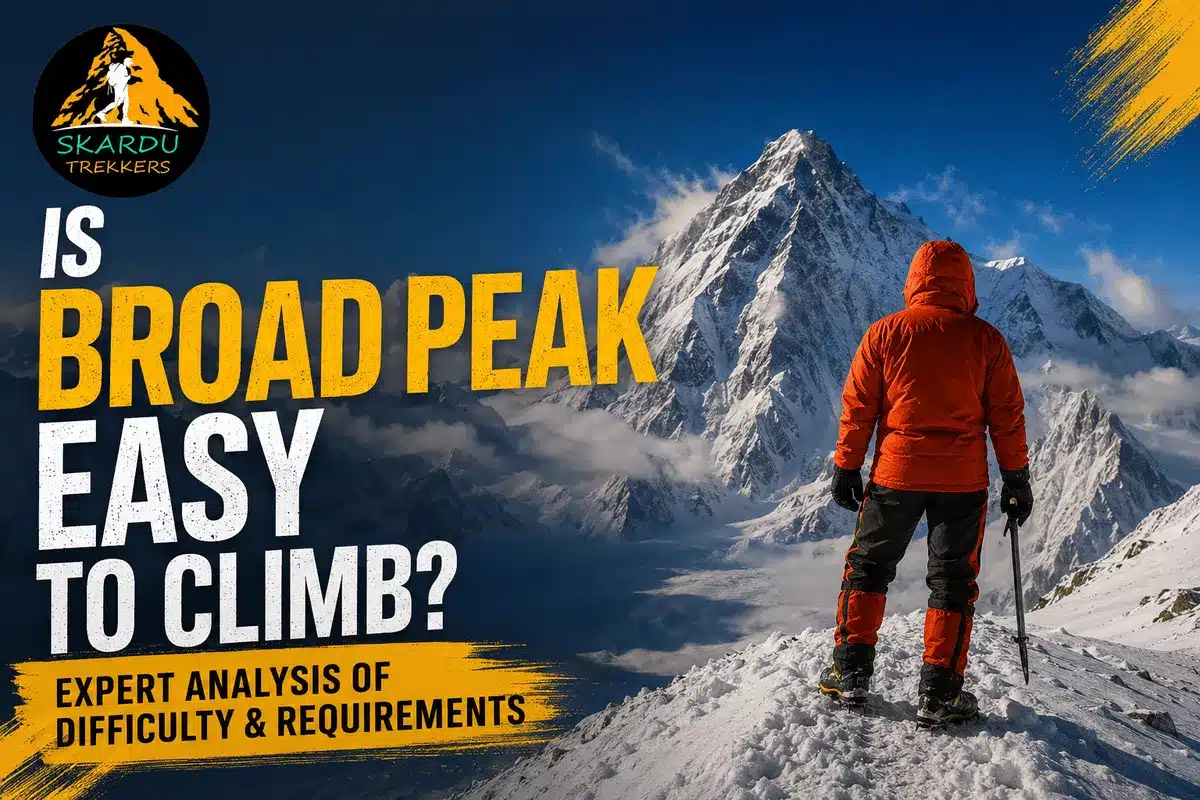
Broad Peak Climbing Difficulty: Is It Really an Easy 8,000er?
Broad Peak is often described online as an “accessible 8,000-meter peak” and that reputation isn’t wrong, exactly, but it needs context most quick answers skip. Compared to K2, sitting just 8km away across the Godwin-Austen Glacier, Broad Peak’s standard route genuinely involves less sustained technical climbing. Compared to not climbing an 8,000m peak at all, it is still one of the most physically demanding things a person can attempt. This guide breaks down exactly what “accessible” does and doesn’t mean here, so you can judge honestly whether Broad Peak is the right climb for you.
What Does “Easy” Mean in the Context of 8,000m Peaks?
Defining “Accessible”
Among the fourteen peaks over 8,000m, Broad Peak is genuinely considered one of the more approachable commonly ranked as Pakistan’s second-easiest eight-thousander after Gasherbrum II. The reasoning is straightforward: its standard route has no sustained technical crux comparable to K2’s Bottleneck or the Abruzzi Spur’s rock steps, and it’s often climbed as an acclimatization objective ahead of a K2 attempt. But “easier than K2” is a comparison between two extremely serious mountains, not a claim that Broad Peak is easy in any absolute sense.
Understanding the 8,000m Challenge
Every 8,000m peak shares the same baseline dangers: oxygen levels around a third of sea-level pressure, unpredictable high-altitude weather, and the risk of HACE and HAPE (high-altitude cerebral and pulmonary edema), both of which can turn fatal within hours if a climber doesn’t descend. On Broad Peak specifically, the defining challenges are a long summit day, crevasse-crossed glacier terrain on the approach, and steep, sustained sections between camps that demand solid technique even though they’re shorter than K2’s technical stretches.
Technical Difficulty Assessment
Climbing Route Complexity
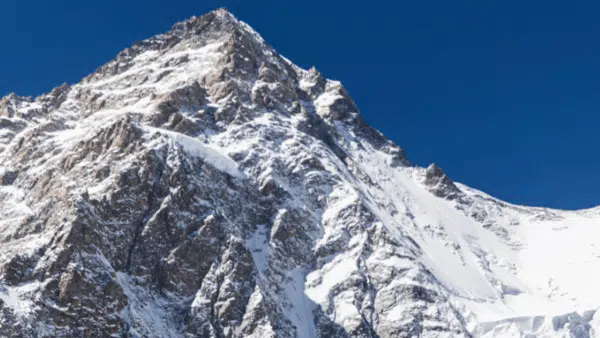
Broad Peak’s standard route is the West Spur (also called the West Ridge), first climbed by the 1957 Austrian expedition and still used by nearly every ascent today. From base camp on the Godwin-Austen Glacier, the route climbs a steepening line of snow and ice to a high col, with the steepest sustained climbing typically found between Camp 1 and Camp 2 a section normally fixed with rope. From the col, the route traverses toward the summit ridge itself.
One detail that catches out even experienced climbers: many stop at the Rocky Summit (roughly 8,028m), a false summit that looks and feels like the top. The true summit sits another 20–30 minutes beyond, across an exposed, corniced ridge the same confusion that famously affected Polish climber Maciej Berbeka in 1988, a story we cover in full in our Complete Guide to Climbing Broad Peak.
Equipment required for the technical sections: ice axe, crampons, a climbing harness, and ascending devices for the fixed-rope stretches, along with solid rope-work fundamentals for glacier travel on the approach.
Broad Peak vs. Other 8,000m Peaks
| Peak | Height | Relative Difficulty | Technical Character |
| Gasherbrum II | 8,035m | Lower | Straightforward glacier route; often called Pakistan’s easiest 8,000er |
| Broad Peak | 8,051m | Moderate | No sustained technical crux; long exposed summit ridge is the main challenge |
| Mount Everest | 8,849m | High, but heavily supported | Extensive fixed ropes and infrastructure reduce technical demand relative to altitude |
| K2 | 8,611m | Extreme | Sustained technical climbing, the Bottleneck serac hazard, high fatality rate |
A note on precision here: exact numeric success rates circulating online for these peaks vary considerably by source, season, and year, and aren’t consistently tracked by a single public authority the way, say, aviation safety data is. Rather than quote a specific percentage we can’t fully stand behind, the honest comparison is qualitative: Gasherbrum II is generally regarded as the gentlest introduction to 8,000m climbing, Broad Peak the next step up, Everest benefits from far more fixed infrastructure and guiding support despite its extra 800m of altitude, and K2 remains in a category of its own for both technical difficulty and historical fatality rate.
Physical Requirements for Broad Peak
Fitness Level Needed
Climbing Broad Peak demands serious cardiovascular endurance for sustained effort at extreme altitude, along with real strength for carrying loads on the approach and pushing through deep, unbroken snow on summit day. Most climbers begin dedicated training at least six months out, combining altitude-specific cardio with load-carrying hikes and strength work.
Previous Experience Requirements
At minimum, climbers should have prior experience on a 6,000m+ peak before attempting Broad Peak. Two or more high-altitude expeditions is a stronger foundation. Core skills that matter more here than raw fitness alone: self-arrest technique, confident crampon use on mixed snow and ice, and comfort moving on fixed ropes for extended periods.
Acclimatization Challenges
The Acclimatization Process
The body needs time to adapt to reduced oxygen at altitude, and there’s no way to shortcut this safely. Broad Peak expeditions generally build in two to three weeks of gradual ascent, following the well-established “climb high, sleep low” principle pushing to a higher camp during the day, then descending to sleep at a lower, better-oxygenated altitude to aid recovery.
Common Acclimatization Schedules
A full Broad Peak expedition typically runs around 40–50 days including the trek in and out, structured around a rotation system: climbers move progressively higher through Camps 1 to 3 or 4, descending to base camp to recover between pushes, before a final summit attempt when the weather window opens. See our Broad Peak Expedition page for our current itinerary and rotation schedule.
Altitude Sickness Symptoms
Early symptoms of altitude sickness include headache, nausea, fatigue, and dizziness common enough during acclimatization that they need careful monitoring rather than panic. Severe symptoms are a different matter entirely: confusion, loss of coordination, and shortness of breath at rest are signs of HACE or HAPE, and demand immediate descent. Waiting to see if symptoms improve is one of the most dangerous mistakes climbers make at altitude.
Weather Challenges on Broad Peak
Typical Weather Patterns
Broad Peak’s climbing season runs June to August, generally with clearer mornings and a higher chance of afternoon storms building through the day a pattern common across the Karakoram. Temperatures swing dramatically with altitude and time of day; base camp can feel relatively mild in summer sun, while the upper mountain and summit day bring genuinely extreme cold, especially with wind chill factored in.
Weather-Related Risks
The core weather risks on Broad Peak are sudden storms that can close in with little warning, high winds strong enough to make upper-mountain movement dangerous, and unstable snow conditions that raise avalanche risk, particularly on the lower and mid-sections of the route after fresh snowfall. This isn’t a theoretical risk it’s the same pattern behind most of Broad Peak’s historical fatalities, including the catastrophic 2026 avalanche
Success Rate Analysis
Broad Peak Total Successful Summits
Summit numbers have grown substantially since the mountain’s first ascent in 1957, with early decades seeing only a handful of successful climbs per year and more recent seasons seeing considerably higher traffic, as 8,000m mountaineering in general has become more commercially accessible.
What Affects Success Rate?
The clearest factors separating a successful summit from a turnaround are weather-window timing, acclimatization discipline (rushing the rotation schedule is a common cause of failure), physical fitness reserves for the long summit day, and the experience level of the support team. Bad weather and altitude sickness remain the two most common reasons climbers turn back below the summit. Our Broad Peak Expedition is built around exactly these factors a realistic rotation schedule and experienced guiding to maximize your genuine chance of success, not just a fast itinerary.
Is Broad Peak the Right Climb for You?
Who Should Climb Broad Peak?
Broad Peak suits climbers who already have 6,000m+ altitude experience and solid fundamental mountaineering skills, and who want a genuine 8,000m objective without the sustained technical demands of K2. It is not recommended for absolute beginners to high-altitude climbing the altitude and endurance requirements alone rule that out, regardless of the route’s relative technical simplicity.
Broad Peak vs. Other First 8,000m Peaks
Climbers weighing their first eight-thousander often compare Broad Peak against Gasherbrum II, Cho Oyu, and Shishapangma all commonly cited as gentler entry points into 8,000m mountaineering. Broad Peak’s advantage is its Karakoram setting: the approach through the Baltoro Glacier to Concordia is widely regarded as one of the most spectacular treks in world mountaineering, and its proximity to K2 makes it a natural first step for climbers with the Savage Mountain as an eventual goal.
Book Your Broad Peak Expedition
Ready to find out if Broad Peak is the right challenge for you? Contact us for an honest assessment based on your experience, or head straight to our Broad Peak Expedition page for full itinerary, dates, and pricing.



Comments are closed