


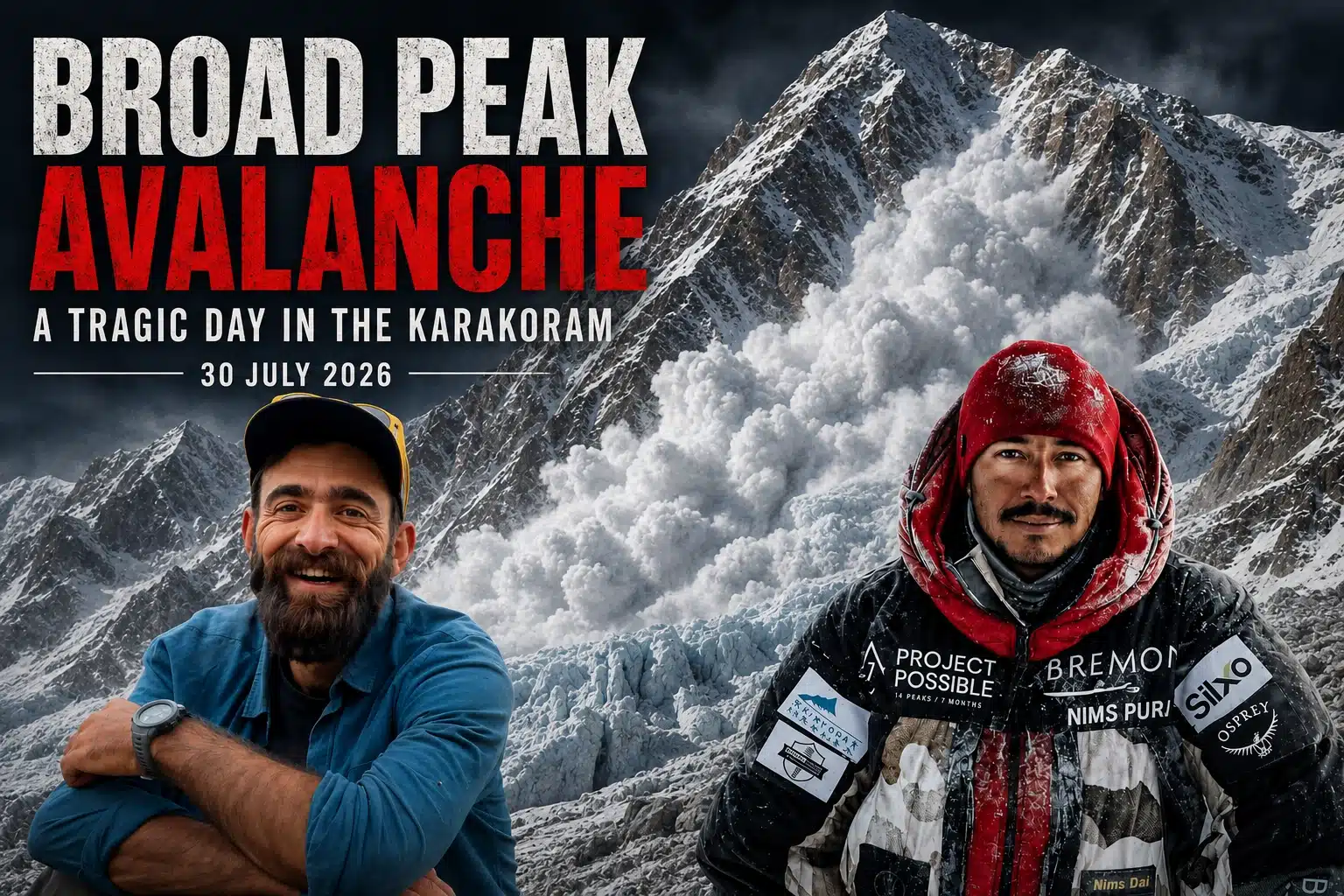
Broad Peak Avalanche 2026: What Happened to 10 Climbers?
Broad Peak became the scene of a devastating mountaineering accident in late July 2026. On July 30, a powerful avalanche swept through the route above Camp II while an international group was climbing toward the higher camps. What began as a summit push quickly became a prolonged search and recovery effort.
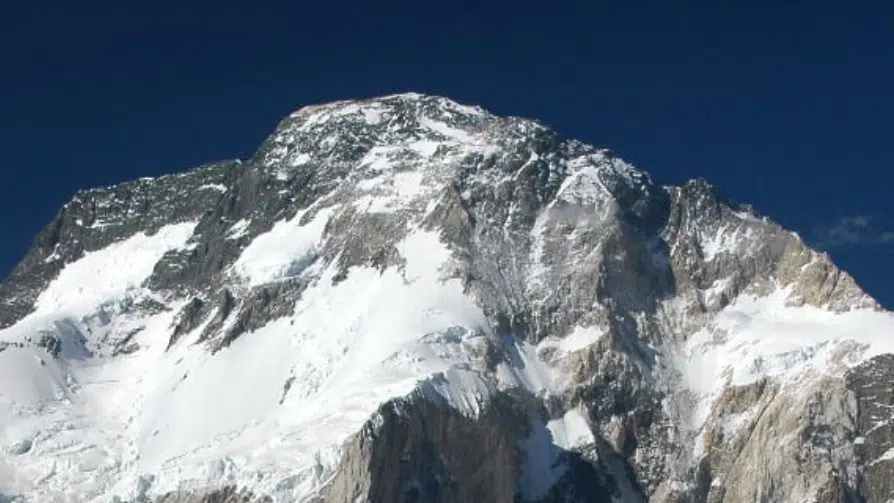
Ten climbers from four expeditions were caught in the disaster. Among them was Nirmal “Nimsdai” Purja, the Nepal-born mountaineer who became globally known after climbing all 14 of the world’s 8,000-meter peaks in a record 189 days.
At first, there was uncertainty about what had happened to the team. However, tracker data, aerial searches and later ground operations gradually revealed the extent of the tragedy.
Ultimately, all ten climbers were confirmed dead.
The final missing climber, American mountaineer Sarah Mallory Geis, was located by local volunteers on August 21, ending the search for the last missing member of the group. Nawang Thindu Sherpa’s remains, however, could not be safely brought down because of the severe hazards in the area where he was located.
Broad Peak Avalanche 2026 at a Glance
- Mountain: Broad Peak
- Elevation: 8,051 m / 26,414 ft
- Location: Gilgit-Baltistan, Pakistan
- Date of avalanche: July 30, 2026
- Approximate time: Around 9:00 a.m. local time
- Area: Above Camp II, on the route toward Camp III
- Climbers caught: 10
- Expeditions involved: 4
- Final death toll: 10
- Countries represented: Nepal, Pakistan, Oman, China, the United Kingdom and the United States
- Notable victim: Nirmal “Nimsdai” Purja
- Final missing climber located: Sarah Mallory Geis, August 21, 2026
Broad Peak is the world’s 12th-highest mountain and rises to approximately 8,051 meters above sea level. Its standard route contains exposed avalanche terrain between Camp II and Camp III, making the upper mountain particularly hazardous after periods of heavy snowfall. This combination of altitude, terrain and unstable snow is central to understanding the Broad Peak avalanche 2026.
How the Broad Peak Avalanche 2026 Unfolded
The accident followed a period of unsettled weather in the Karakoram. Fresh snow had accumulated on the mountain, and climbers were making decisions within a narrow weather window. Those conditions form an important part of the story behind the Broad Peak avalanche 2026.
Reports from the mountain described substantial snowfall in the days before the accident. As a result, the fresh snow load became a major concern for climbers and guides watching the route.
Experienced climbers who had been on Broad Peak earlier in the season had already started leaving the mountain. National Geographic reported that most teams at Base Camp had departed by July 25 because of concerns surrounding the fresh snowfall. Others, however, remained in the hope of finding a workable summit window.
Outside reported that ten climbers left Broad Peak Base Camp on July 28 and moved toward Camp I. They represented four different expeditions but were climbing on broadly similar schedules.
The group moved through Camp I and then Camp II.
The route above Camp II becomes increasingly exposed, and the climbers had to cross avalanche-prone terrain on their way toward Camp III.
On the morning of July 30, the climbers began moving upward.
GPS data later reconstructed their movements.
At approximately 5:33 a.m., the four groups were around Camp II. By approximately 7:30 a.m., they were progressing higher.
Just before 9 a.m., Nims Purja’s tracker recorded an elevation of approximately 21,847 feet.
It was the highest recorded position reached by anyone in the group.
Then the trackers changed dramatically.
The Avalanche
At approximately 9 a.m. on July 30, a massive avalanche came down the mountain’s main west-facing gully.
Jenjen Lama, a guide with Seven Summit Treks who was climbing on nearby K2, reportedly saw the avalanche from across the valley.
He immediately attempted to contact climbers on Broad Peak by radio.
There was no response.
At first, the absence of radio communication did not necessarily mean disaster. Climbers at high altitude frequently lose communication because of terrain, weather or equipment issues.
But when the expedition teams checked the GPS trackers, the situation became clear.
Several trackers showed sudden and extremely rapid descents. The data later became an important part of reconstructing the Broad Peak avalanche 2026 timeline.
Outside reported that one track showed a descent of more than 5,000 vertical feet, indicating that the avalanche had carried the climber far down the mountain.
The climbers had not simply stopped transmitting.
They had been swept away.
Where Did the Broad Peak Avalanche Strike?
The avalanche struck above Camp II on the route toward Camp III.
This is an especially exposed section of Broad Peak’s standard route.
According to reporting from Le Monde and other mountaineering sources, the climbers were roughly between 6,450 and 7,000 meters when the disaster occurred.
The exact mechanics of the avalanche remain difficult to reconstruct completely. Early reports differed on some details, so this article does not present unverified theories as established fact.
Some reports have discussed the possibility of more than one avalanche, but the Alpine Club of Pakistan stressed that only one major avalanche had been confirmed at the time of the initial investigation.
What is clear is that the avalanche was extraordinarily powerful.
Tracking data indicated that climbers were carried hundreds of meters down the mountain, while rescue teams later found bodies and equipment far below their expected positions.
Why Was Broad Peak So Dangerous in 2026?
Avalanches are not unusual on Broad Peak.
The mountain’s standard route includes exposed slopes where accumulated snow can release naturally or be triggered by changing conditions.
The major concern in the days before July 30 was the amount of new snow.
After a heavy snowfall, the new snow needs time to bond and stabilize.
But on an 8,000-meter mountain, waiting for perfect conditions is complicated by short weather windows.
Outside reported that the Karakoram received heavy snowfall between July 22 and July 26. Guides explained that climbers normally want several days for fresh snow to settle, but waiting too long can mean losing the next available summit window.
This created a difficult central dilemma:
Wait and potentially lose the season, or climb while the mountain remains unstable.
The tragedy demonstrated how quickly that decision can become irreversible. Nevertheless, the available evidence does not establish that any individual climber acted recklessly; high-altitude decisions involve weather, acclimatization, route conditions and limited summit windows.
The Four Expeditions Involved in the Broad Peak Avalanche 2026
The ten climbers caught in the avalanche were associated with four different teams.
1. Elite Exped
The expedition led by Nirmal “Nimsdai” Purja was organized through Elite Exped.
Purja was attempting another major milestone in his already extraordinary mountaineering career.
He was pursuing the possibility of climbing all 14 eight-thousanders twice without supplemental oxygen.
Before the climb, Purja publicly posted about Broad Peak and expressed his hope for a safe ascent and descent.
His Instagram message later became one of the most widely shared pieces of the tragedy.
Elite Exped officially confirmed Purja’s death on August 1, saying that he had lost his life in the Broad Peak avalanche and that other members of the expedition had also died.
2. Seven Summit Treks
Another group was climbing with Seven Summit Treks.
The team was supporting Omani mountaineer Nadhira Al Harthy.
She had become the first Omani woman to summit Mount Everest in 2019 and was continuing her pursuit of the world’s highest mountains.
She was accompanied by experienced Nepali Sherpas, including Gyaljen “Gyalu” Sherpa and Nawang Thindu Sherpa.
Outside reported that Nawang Thindu had already completed five 8,000-meter ascents.
3. Imagine Nepal
A third group was connected with Imagine Nepal.
The team included veteran Nepali guide Kili Pemba Sherpa, widely known as “Kilu,” and Chinese climber Wang Zhong.
Kilu was an exceptionally experienced high-altitude climber. He had numerous Everest summits and had been part of Nepal’s historic first winter ascent of K2 in 2021.
4. Pakistani-American Team
The fourth team consisted of Pakistani guide Sohail Sakhi and American climber Sarah Mallory Geis.
Sakhi was an accomplished Pakistani high-altitude climber with ascents of several 8,000-meter peaks.
Geis was attempting her first 8,000-meter summit.
Outside reported that she had previously climbed peaks including Mera Peak and Lobuche East and had decided to pursue mountaineering more seriously.
Who Were the Ten Climbers Killed in the Broad Peak Avalanche 2026?
The tragedy claimed the lives of ten climbers and guides from several countries. Their nationalities and climbing backgrounds make clear that the avalanche affected both highly experienced professionals and climbers pursuing major personal goals.
The victims included:
- Nirmal “Nimsdai” Purja — Nepal / UK
- Pur Bahadur Gurung “Yukta” — Nepal
- Nima Sherpa — Nepal
- Kili Pemba Sherpa “Kilu” — Nepal
- Gyaljen “Gyalu” Sherpa — Nepal
- Nawang Thindu Sherpa — Nepal
- Sohail Sakhi — Pakistan
- Nadhira Al Harthy — Oman
- Wang Zhong — China
- Sarah Mallory Geis — United States
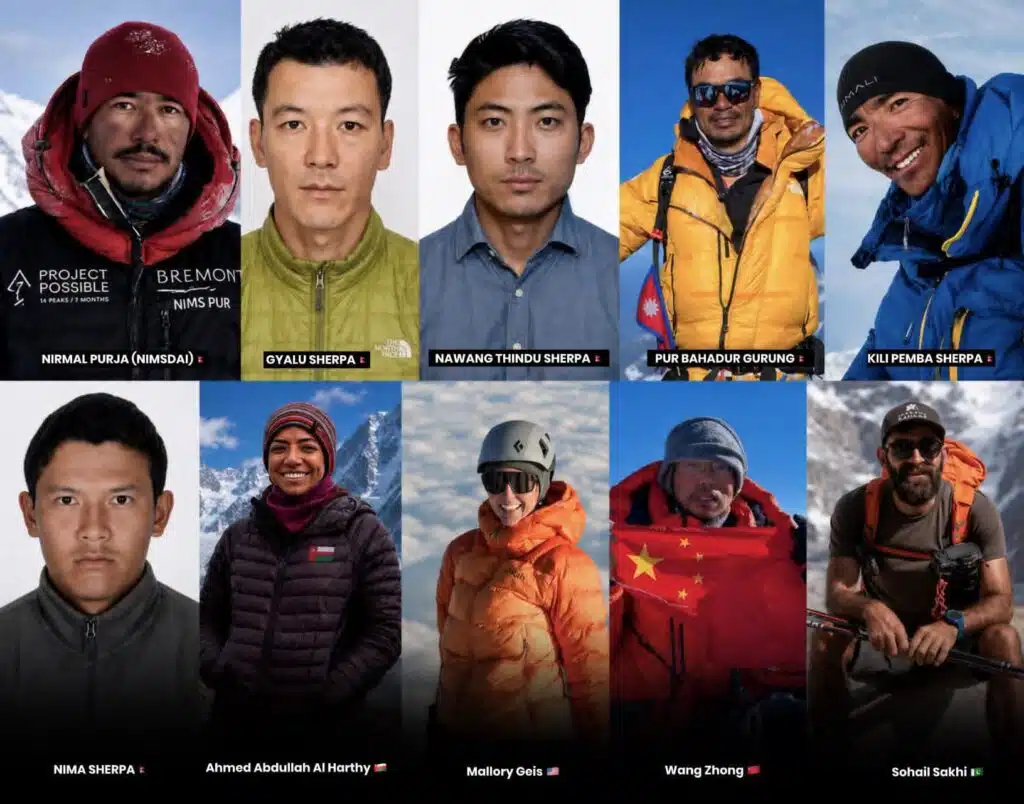
The Nepali Ministry of Foreign Affairs issued a statement concerning the Nepali climbers on Broad Peak following the avalanche.
Nirmal “Nimsdai” Purja
Nims Purja was the most internationally recognized member of the expedition.
He became famous in 2019 after climbing all 14 of the world’s 8,000-meter peaks in just 189 days.
His achievement dramatically changed the speed at which high-altitude expeditions could be conducted and made him one of the most recognizable figures in modern mountaineering.
His story later reached a global audience through the Netflix documentary 14 Peaks: Nothing Is Impossible.
At the time of the Broad Peak expedition, Purja was pursuing another extraordinary objective: climbing all 14 eight-thousanders twice without supplemental oxygen.
His death therefore represented not only a personal tragedy but also the loss of one of the most influential figures in contemporary high-altitude climbing.
Pur Bahadur Gurung “Yukta”
Pur Bahadur Gurung, known as Yukta, was an experienced Nepali mountaineer and mountain guide.
He had extensive high-altitude experience and had recently completed his IFMGA certification, one of the highest professional qualifications available to mountain guides.
His body was recovered and later repatriated to Nepal, where family members and members of the mountaineering community gathered to receive him.
Nadhira Al Harthy
Nadhira Al Harthy was an Omani mountaineer and a pioneer for mountaineering in Oman.
She became the first Omani woman to climb Mount Everest in 2019.
She continued pursuing major Himalayan and Karakoram objectives and had ambitions connected with the 14 eight-thousanders.
Her death was widely mourned in Oman, where she was remembered for her determination and achievements in mountaineering.
Nawang Thindu Sherpa
Nawang Thindu Sherpa was among the younger members of the expedition and already had significant high-altitude experience.
His body was located high on Broad Peak but became one of the most difficult recoveries of the entire operation.
Rescuers attempted to reach him through the avalanche path but faced steep terrain, crevasses, overhanging sections and the constant threat of additional avalanches.
At one point, the rescuers ran out of rope and had to retreat.
They ultimately determined that attempting to recover his body would place additional lives at unacceptable risk.
The Broad Peak Avalanche 2026 Rescue Operation
The rescue operation began as soon as the scale of the accident became known. However, rescuers faced the same unstable mountain that had trapped the climbers.
But Broad Peak presented an extremely difficult rescue environment.
The avalanche had occurred at high altitude, weather remained unstable, the terrain was steep and exposed, and the rescuers themselves faced the possibility of additional avalanches.
Pakistani Army helicopters were used for aerial reconnaissance and rescue support, while climbers and expedition leaders used drones to search areas that were impossible to inspect from the ground.
Drone footage became particularly important.
It allowed rescuers to identify bodies that could not initially be reached.
Reuters reported that teams had identified victims using drone footage but that recovering them safely remained extremely difficult because of the terrain and limitations of high-altitude helicopter rescue capability in Pakistan.
How Local Porters from Tissar, Shigar Recovered Sohail Sakhi
One of the most remarkable chapters of the Broad Peak avalanche 2026 recovery was the discovery and retrieval of Pakistani climber Sohail Sakhi’s body by local volunteers from Tissar village in Shigar.
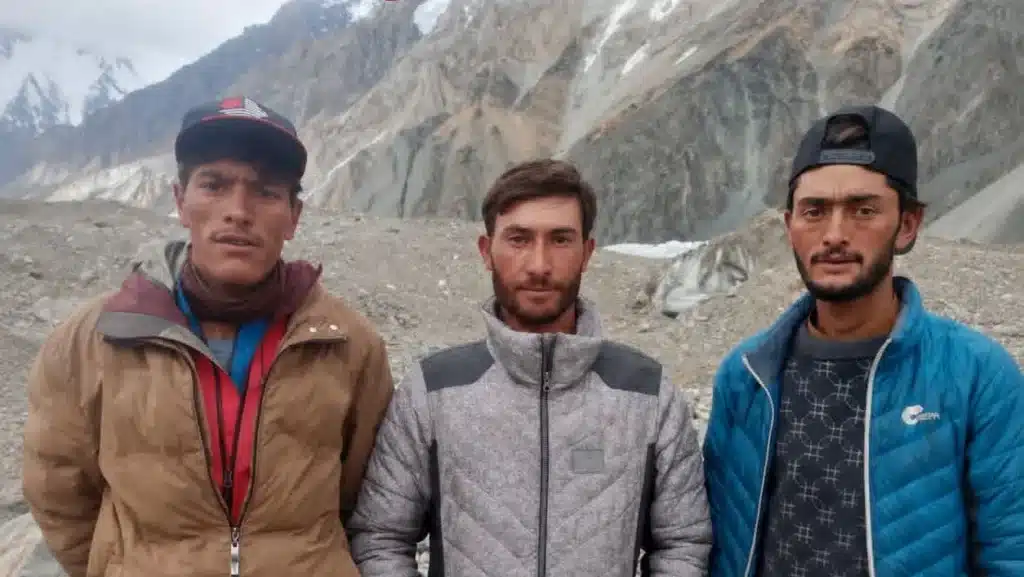
Sakhi had remained missing for nearly two weeks after the July 30 avalanche. Official recovery efforts had faced severe danger from unstable snow and avalanche-prone terrain, and the search for three remaining climbers was suspended on August 8 because of the continuing risk of fresh avalanches. On August 13, three local volunteers from Tissar Muhammad Nadeem, Muhammad Bashir and Abuzar found Sakhi’s remains while searching the area on their own initiative. The Alpine Club of Pakistan confirmed the recovery that day.
According to reporting on the recovery, the three men were local volunteers rather than the main official rescue team. They found the remains at about 5,600 metres and alerted others in the area. They then began the difficult task of freeing and moving the body through the avalanche debris.
The volunteers worked through the snow and debris and, with help from others, carried Sakhi’s body down from around Camp I to Broad Peak Base Camp. Dawn reported that the body had been located at approximately 5,600 metres. This local effort became one of the most significant human stories to emerge from the recovery operation.
At Base Camp, authorities confirmed Sakhi’s identity. The body was subsequently airlifted from Broad Peak Base Camp to Skardu by Pakistan Army helicopter when weather permitted. He was later laid to rest in his hometown of Aliabad in Hunza.
The recovery was especially significant because these local volunteers acted on their own initiative and accepted considerable risk to bring a fellow Pakistani climber home. Their effort also highlighted the important, often unseen role played by people from Shigar’s mountain communities in supporting expeditions and difficult recovery operations across the Karakoram.
Drone Search
The drone operation provided some of the first clear evidence of the scale of the disaster.
Rescuers eventually identified a cluster of bodies high on the mountain.
One of the figures was recognized by his distinctive clothing.
It was Nirmal Purja.
Other bodies in the same area were later identified as:
- Nima Sherpa
- Wang Zhong
- Kili Pemba Sherpa
- Gyaljen “Gyalu” Sherpa
The recovery team then had to climb into the avalanche zone to retrieve them.
Additional Avalanche Risk During the Recovery
The rescue itself became another life-threatening expedition.
While rescuers were attempting to recover Nawang Thindu Sherpa, additional snow movement occurred on the mountain.
Outside reported that rescuers heard another powerful avalanche while they were inside the steep couloir.
Later, another major avalanche swept down the route and disrupted the recovery operation.
This demonstrated one of the most difficult realities of high-altitude rescue:
The mountain does not become safer simply because people are there to recover the dead.
Every rescuer entering the avalanche zone becomes another potential victim.
The rescuers therefore had to constantly balance the desire to bring climbers home against the possibility of creating additional casualties.
The Search for Sarah Mallory Geis
Sarah Mallory Geis became the last missing member of the ten-person group.
Early reports confused the recovery because rescuers initially found human remains they believed belonged to her.
Later reports clarified that rescuers had recovered only part of her remains, while the rest of her body remained on the mountain.
For weeks, the search continued.
On August 21, volunteer rescuers finally located Geis’s remains, bringing the search for the last missing member of the ten-person expedition to an end.
Her recovery brought closure to the search for the ten climbers.
Outside reported that local porters were involved in moving her remains toward Base Camp, with plans for eventual transport toward Skardu.
Her family had publicly emphasized that their priority was bringing her home.
Geis was 39 years old and from San Antonio, Texas. Broad Peak was her first attempt at an 8,000-meter summit, and she had recently closed her Pilates studio to focus more seriously on mountaineering.
Nawang Thindu Sherpa and the Limits of Recovery
Although rescuers ultimately located all ten expedition members, they faced their most difficult recovery with Nawang Thindu Sherpa’s remains and could not safely bring them down.
They found his body in extremely dangerous terrain.
Experienced Sherpas attempted to reach him with hundreds of meters of rope, but the terrain included steep snow, crevasses and avalanche-prone slopes.
At one point, rescuers were directly exposed to another avalanche.
The decision not to continue the recovery was not a lack of effort.
It was a recognition that sending more climbers into an unstable avalanche path could create another tragedy.
This is one of the hardest lessons from the Broad Peak disaster: sometimes even highly experienced rescuers cannot safely bring every victim down from an 8,000-meter mountain.
What Did Social Media Reveal About the Broad Peak Avalanche 2026?
Social media became an important source of information during the disaster. However, it also created confusion because early reports changed as rescuers confirmed identities and recovered additional remains.
Nims Purja had posted about Broad Peak before the climb, including a message asking the mountain for “safe passage up and back down.”
That post later became one of the most haunting pieces of the story because it was published shortly before his death.
Elite Exped subsequently confirmed Purja’s death through its social-media channels.
The announcement was followed by an enormous international response from climbers, athletes, political leaders and members of the global mountaineering community.
Other social-media posts and videos from climbers, families and mountaineering organizations helped document the victims’ lives and the recovery operation.
However, social media also produced conflicting information during the first days.
This is important.
Not every photograph, body count or rescue claim circulating on Facebook, Instagram, TikTok or X was accurate.
The situation changed rapidly as drones located bodies, identities were confirmed and recovery teams reached different parts of the mountain.
For a reliable account, official expedition statements, Alpine Club of Pakistan information, government statements and established reporting should take priority over unverified social-media claims.
Why Had Other Climbers Left Broad Peak?
One of the most important details surrounding the tragedy is that several experienced climbers had already decided to leave the mountain.
The reason was changing mountain conditions.
Heavy snowfall had transformed the route.
Experienced climbers recognized that fresh snow can create unstable layers and increase avalanche danger.
National Geographic reported that many teams had already departed Broad Peak before the fatal summit push.
This does not mean that the remaining climbers made a reckless decision.
High-altitude mountaineering involves complex decisions involving weather forecasts, acclimatization, route conditions, expedition schedules, permits, logistics and limited weather windows.
A decision that appears obvious after a disaster may have looked very different to climbers standing at Camp II before the avalanche.
That is why it is important not to reduce the tragedy to a simple question of who was “right” or “wrong.”
Could Climbers Have Prevented the Broad Peak Avalanche?
There is no confirmed evidence that allows us to say with certainty that the Broad Peak avalanche 2026 could have been prevented.
Several factors appear to have contributed to the danger:
- Heavy snowfall in the days before the summit attempt
- Fresh unstable snow
- Short weather windows
- Avalanche-prone terrain above Camp II
- Extreme altitude
- Complex route conditions
- Limited time available for snow stabilization
- The inherent unpredictability of high-altitude avalanches
The available evidence suggests that conditions had become significantly more dangerous after the late-July snowfall.
But mountaineering accidents rarely have a single cause.
The Broad Peak tragedy was the result of a dangerous combination of mountain conditions, timing, terrain and human exposure to an inherently hazardous environment.
Why Broad Peak Remains So Dangerous
Broad Peak is sometimes considered one of the more accessible 8,000-meter peaks because climbers may face fewer technical difficulties than on K2.
But “less technical” does not mean “safe.”
At 8,051 meters, Broad Peak lies firmly within the death zone.
The mountain is exposed to:
- Avalanches
- Rockfall
- Extreme cold
- High winds
- Crevasses
- Altitude sickness
- Rapid weather changes
- Exhaustion
- Long summit routes
- Difficult descent conditions
The section between Camp II and Camp III is particularly important because climbers must cross exposed avalanche terrain.
Outside described Broad Peak’s standard route as long, steep and sustained, with an exposed avalanche slope between Camp II and Camp III.
The Human Cost of the Broad Peak Avalanche 2026
Behind the numbers are ten individual lives.
They were not simply “ten climbers.”
They were guides, athletes, professionals, fathers, family members, friends and people who had dedicated years to the mountains.
Some had already climbed several 8,000-meter peaks.
Others were chasing a lifelong dream of reaching the world’s highest mountains.
Several made their living as professional mountain guides, with years of experience in extreme high-altitude terrain.
And for Sarah Mallory Geis, Broad Peak represented her first attempt at an 8,000-meter summit.
For Nims Purja, it was another step toward an unprecedented mountaineering goal.
For the Sherpa guides, years of experience prepared them for another high-altitude assignment.
The avalanche did not distinguish between elite climbers and first-time 8,000-meter aspirants.
That is the brutal reality of the world’s highest mountains.
A Tribute to the Ten Climbers
The Broad Peak tragedy is a reminder that mountaineering is never only about reaching a summit.
The mountain remains after the climber leaves.
The summit remains.
The glaciers remain.
The avalanche paths remain.
But the people who climb them may not return.
Nirmal Purja’s legacy will remain deeply connected to his extraordinary achievements and his influence on modern high-altitude mountaineering.
Pur Bahadur Gurung, Nadhira Al Harthy, Nima Sherpa, Kili Pemba Sherpa, Gyaljen Sherpa, Nawang Thindu Sherpa, Sohail Sakhi, Wang Zhong and Sarah Mallory Geis each had their own stories, ambitions and families.
Their lives deserve to be remembered beyond the circumstances of their deaths.
What the Broad Peak Avalanche 2026 Teaches Mountaineers
The disaster offers several important lessons for future expeditions.
1. Fresh snow can radically change a route
A route that was relatively manageable days earlier can become extremely dangerous after heavy snowfall.
2. Weather windows must be treated carefully
A clear day does not necessarily mean a stable mountain.
3. Avalanche danger can remain after snowfall stops
The most dangerous period may continue after the storm has passed.
4. Rescue at 8,000 meters is extremely limited
Even when victims are located, bringing them down can be more dangerous than locating them.
5. Technology helps—but cannot replace judgment
GPS trackers, drones, radios and helicopters played critical roles during the Broad Peak rescue.
But technology could not eliminate the mountain’s hazards.
6. Experienced climbers still face uncontrollable risks
The ten victims included some of the world’s most experienced high-altitude climbers.
Experience reduces risk.
It does not remove it.
Final Thoughts: Remembering the Broad Peak Avalanche 2026
The Broad Peak avalanche 2026, which struck on July 30, will remain one of the darkest chapters in Pakistan’s modern mountaineering history.
Ten climbers went toward the upper mountain, and all ten ultimately died.
The disaster claimed Nirmal Purja, one of the world’s most recognizable mountaineers, along with experienced Sherpas, guides and climbers from several countries.
For weeks, rescuers continued working in conditions where another avalanche could have taken more lives.
The recovery of Sarah Mallory Geis on August 21 finally brought the search for the ten-member group to its conclusion. However, Nawang Thindu Sherpa’s remains could not safely be brought down because of the danger involved in reaching them.
Broad Peak is not simply a number on a list of 8,000-meter mountains. The Broad Peak avalanche 2026 showed once again how quickly conditions can change on an 8,000-meter peak.
It is a powerful and unpredictable mountain in the heart of the Karakoram.
The tragedy reminds everyone—from professional climbers to trekking companies and visitors to the region—that the mountains of northern Pakistan deserve respect.
The summit is never guaranteed. The descent is part of the climb. And sometimes, the mountain decides.




Comments are closed