


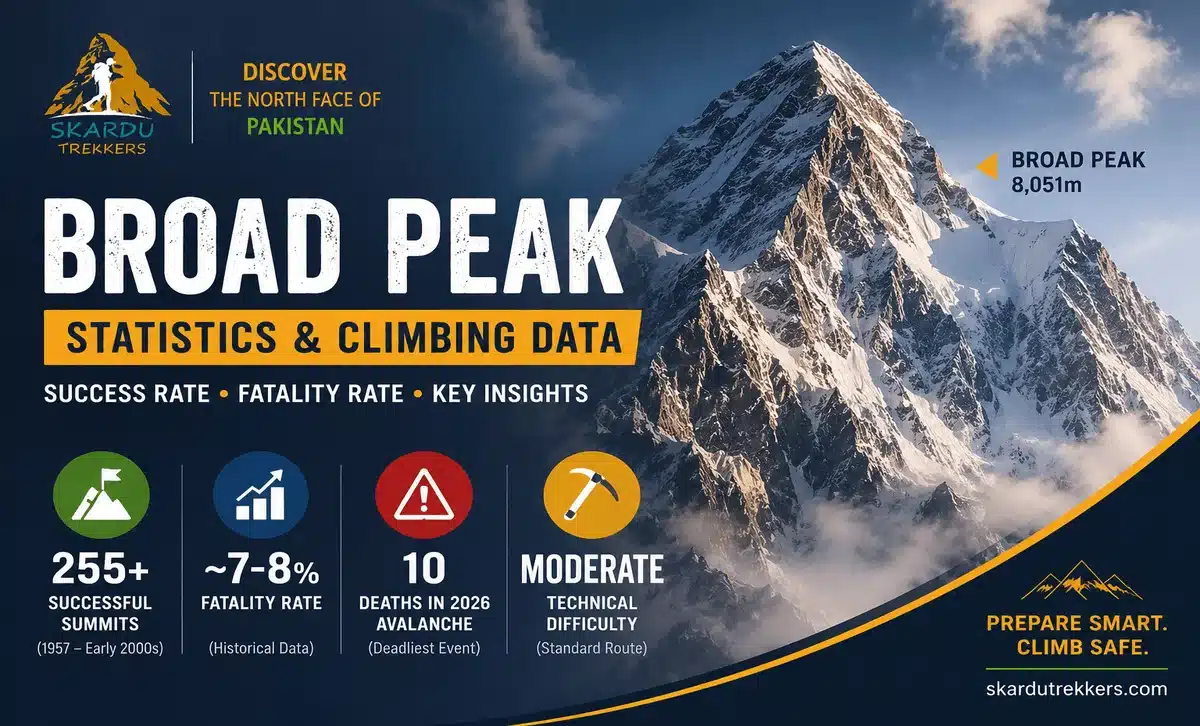
Broad Peak Statistics: Success Rate, Fatality Rate & Climbing Data
Understanding a mountain’s real statistics not just its marketing reputation matters when you’re deciding whether to commit months of training and tens of thousands of dollars to an expedition. Broad Peak is frequently called an “accessible” 8,000m peak, and the historical data broadly supports that compared to K2. But data changes, and Broad Peak’s most important recent statistic is a grim one: the July 2026 avalanche that killed ten climbers, the deadliest single event in the mountain’s history. This post lays out what’s actually known, transparently, including where the data is solid and where it isn’t. For full route and preparation details, see our Complete Guide to Climbing Broad Peak.
Broad Peak Success Rate Analysis
Broad Peak Total Successful Summits
From the first ascent in 1957 through the early 2000s, climbing databases tracked roughly 255 successful ascents of Broad Peak. That number has grown substantially since, as 8,000m mountaineering has become more commercially accessible and annual traffic on the standard route has increased from single digits per year in the mountain’s early decades to considerably higher numbers in recent seasons. We don’t have a single authoritative running total we’re confident quoting to the exact climber the Himalayan Database and similar records are the closest thing to an official tally, and totals reported across different sources vary by methodology and cutoff date.
Success Rate by Climbing Season
The vast majority of successful Broad Peak summits happen in the main June-to-August climbing window, with July typically producing the most stable weather windows. Winter ascents are a separate, far rarer category: as of the 2013 first winter ascent, Broad Peak had been attempted in winter six times, four by Polish teams, with only that single expedition Berbeka, Adam Bielecki, Tomasz Kowalski, and Artur Małek reaching the true summit in that season. Winter success rates are a fraction of summer rates, given the added dangers of extreme cold, high winds, and drastically shortened daylight.
Factors Influencing Success
The clearest drivers of a successful summit are proper acclimatization (rushing the rotation schedule is one of the most common causes of failed attempts), a genuine weather window rather than an optimistic guess, prior high-altitude experience, and the quality and experience of the support team and guides. Climbers who build in adequate rest days and don’t fight the mountain’s schedule consistently fare better than those on compressed itineraries.
Broad Peak Fatality Rate & Safety
Broad Peak Fatality Rate
Historical tracking through the early 2000s calculated Broad Peak’s fatality rate at approximately 7% around 18 deaths across 255 ascents a figure broadly comparable to, and by some analyses slightly better than, Mount Everest’s historical rate over a similar period. More recent estimates from specialist outlets like ExplorersWeb have cited a rate closer to eight deaths per hundred successful summits. It’s important to be direct about what these numbers don’t capture: they predate the 2026 avalanche, which killed ten people in a single event and will materially raise the mountain’s lifetime fatality count and rate once fully incorporated into the historical record. Any “Broad Peak fatality rate” figure you see quoted from before mid-2026 is now out of date.
Broad Peak Deaths: Causes
Fatalities on Broad Peak cluster into a handful of recurring categories, documented across nearly seven decades of expeditions:
- Avalanches the mountain’s most persistent hazard, especially on the lower and mid-sections of the route where slopes load and release without warning. This was the cause of the 2026 tragedy, as well as earlier deaths including a Polish climber killed near Camp 1 during a 1988 winter attempt.
- Falls particularly on the exposed, corniced summit ridge, where a slip can prove fatal even for experienced climbers.
- Altitude sickness (HAPE/HACE) high-altitude pulmonary and cerebral edema, which can kill within hours if a climber doesn’t descend at the first serious symptoms.
- Exhaustion and hypothermia often linked to summit-day pushes that run longer than planned, leaving climbers descending after dark or in worsening weather.
- Disappearances several climbers, including French alpinists Pascale Bessières and Éric Escoffier in 1998, have vanished on the upper mountain during bad-weather descents, their bodies never recovered.
Prevention centers on conservative weather judgment, strict turnaround times regardless of how close the summit feels, disciplined acclimatization, and climbing with guides who know the route’s specific hazard zones particularly the sections most prone to avalanche loading after fresh snow.
How Does Broad Peak Compare in Safety?
Among Pakistan’s 8,000m peaks, K2 carries by far the highest fatality rate of any regularly climbed eight-thousander, driven by its sustained technical difficulty and objective hazards like the Bottleneck serac. Broad Peak has historically sat well below that, among the comparatively lower-fatality-rate peaks alongside Gasherbrum II though “lower fatality rate” is a relative measure among genuinely dangerous mountains, not a safety guarantee, and the 2026 avalanche is a stark reminder that a statistically “safer” 8,000m peak can still produce a catastrophic single event. We’d rather be precise about that than repeat the kind of confident but unsourced comparison chart that circulates in a lot of Broad Peak content online.
Broad Peak Difficulty & Technical Data
Technical Difficulty Rating
Broad Peak is generally rated as moderate difficulty among 8,000m peaks — its standard route lacks the sustained technical crux found on K2, but it still demands real climbing competence, particularly on the steep section between Camp 1 and Camp 2, and full self-sufficiency on the long, exposed summit ridge above. See our companion post on whether Broad Peak is easy to climb for a full technical breakdown.
Climbing Route Statistics
The standard West Spur route runs from base camp at roughly 4,850–5,000m on the Godwin-Austen Glacier to the 8,051m summit a vertical gain of around 3,000–3,200m across four high camps, with Camp 2 typically sitting near 6,300m and Camp 4 near 7,400m. Summit day is long even by 8,000m standards: commonly reported at 10 to 14 hours of climbing to the top, followed by another 4 to 6 hours back down to high camp, which is precisely the kind of extended exposure that makes fatigue-related incidents common on the descent.
Historical Statistics
Climbing Trends Over Time
Broad Peak’s climbing history spans nearly seventy years: from a four-person, oxygen-free alpine-style first ascent in 1957, through decades of growing summer traffic, to today’s larger commercial expeditions with fixed ropes and organized support teams. Equipment, weather forecasting, and route knowledge have all improved substantially since the 1950s, generally supporting higher success rates in recent decades though, as 2026 showed, better equipment doesn’t eliminate the mountain’s underlying objective hazards.
Notable Milestones
- 1954: An early, unsuccessful German-Swiss attempt led by Karl Herrligkoffer is turned back by extreme weather.
- 1957: First ascent, by an Austrian team climbing alpine-style without oxygen or high-altitude porters.
- 1975: First ascent of Broad Peak Central; three of the summiting climbers die in a storm during descent.
- 1983: First female ascent, by Polish climber Krystyna Palmowska on June 30, climbing alpine-style without supplemental oxygen alongside Anna Czerwińska.
- 1988: During a winter side-attempt from a K2 expedition, Maciej Berbeka becomes the first person to climb above 8,000m in the Karakoram in winter, though he mistakenly stops at the Foresummit.
- 2013: First winter ascent of the true summit, by a four-person Polish team; two of the four die during the descent.
- 2019: Nirmal Purja summits Broad Peak during his record-setting climb of all fourteen 8,000m peaks in under seven months.
- 2026: A catastrophic avalanche kills ten climbers, including Purja the deadliest single incident in Broad Peak’s history.
Book Your Broad Peak Expedition
Statistics matter, but preparation is what actually determines your outcome on the mountain. Contact us to plan a Broad Peak expedition built around real acclimatization, experienced guiding, and honest risk assessment, or visit our Broad Peak Expedition page for full details.
Frequently Asked Questions
Is Broad Peak dangerous? Yes. Broad Peak carries the same inherent risks as any 8,000m peak altitude, avalanches, and exposed terrain and while its historical fatality rate has generally sat lower than K2’s, the July 2026 avalanche that killed ten climbers is a serious reminder that no eight-thousander is ever truly “safe.”
Can you climb Broad Peak without oxygen?
Yes, most climbers summit Broad Peak without supplemental oxygen, a tradition dating back to the 1957 first ascent team, though the choice is ultimately up to the individual climber and their guiding team. See our guide on Broad Peak’s real difficulty for what that demands physically.
What is the success rate on Broad Peak?
Precise, universally agreed success-rate figures aren’t consistently published by a single authoritative source, but Broad Peak is generally considered to have one of the higher success rates among 8,000m peaks, thanks to its comparatively straightforward standard route relative to mountains like K2.





Comments are closed