

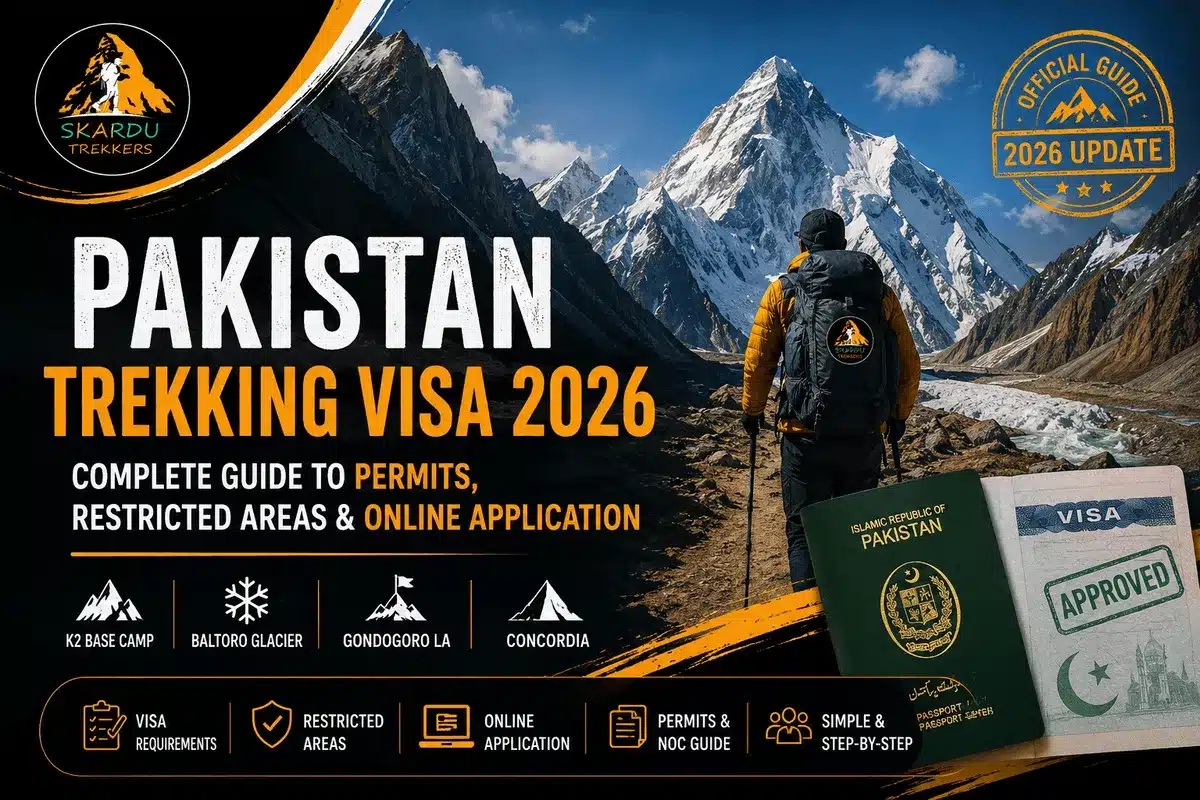
Pakistan Trekking Visa 2026: Complete Guide to Permits, Restricted Areas & Online Application
Pakistan holds five of the world’s fourteen 8,000-metre peaks, including K2. Every year, trekkers come for K2 Base Camp, the Baltoro Glacier, Concordia, and Gondogoro La. But the paperwork confuses many people. As a Gilgit-Baltistan–based trekking advisor, I wrote this guide to make the Pakistan Trekking Visa and permit system clear and simple.
This guide covers what the visa is, who needs it, the documents, the online steps, and the restricted and border-sensitive zones where you need extra permits and security clearance. All details come from official sources: the Pakistan Online Visa System (NADRA) at visa.nadra.gov.pk, the Ministry of Interior, the Pakistan Tourism Development Corporation (PTDC), the Department of Tourist Services (DTS), and the Gilgit-Baltistan government.
Plan early. Restricted-zone clearances can take 4 to 6 weeks or more. Start your application well before your travel dates.
What Is a Pakistan Trekking Visa?
A Pakistan Trekking Visa is a special visa for foreigners who plan to trek in Pakistan’s mountains. It is part of the “Mountaineering & Trekking” category on the official online visa system. You apply for it at visa.nadra.gov.pk/mountaineering-trekking.
Here is a key point many people miss: for foreign trekkers, the trekking and mountaineering visa works as your trekking permit for the route on your application. You do not need to apply for a separate restricted-zone trekking permit if your visa already covers that trek. The visa and the permit are linked.
The trekking visa is usually issued for 30 days and lets you travel across Pakistan.
Who Needs a Trekking Visa?
You need a trekking visa if you are a foreign national who plans to:
- Trek to high-altitude base camps such as K2 Base Camp or Gasherbrum Base Camp
- Walk long glacier routes like the Baltoro Glacier
- Cross high passes such as Gondogoro La
- Join any trek in a restricted zone of Gilgit-Baltistan
You do not automatically need a trekking visa for short, easy walks in open areas (more on zones below). But if your route enters a restricted zone, you must have the trekking visa or the proper permit.
Citizens of around 175–190 countries can apply for this visa online. Indian and Taiwanese passport holders must apply through a Pakistani embassy.
Difference Between a Tourist Visa and a Trekking Visa
This is the most common mistake travelers make. A normal tourist visa is not enough for serious mountain treks.
| Feature | Tourist Visa | Trekking Visa |
| Purpose | Sightseeing, cities, valleys | High-altitude trekking and expeditions |
| Covers restricted zones? | No | Yes (for the route you list) |
| Acts as a trekking permit? | No | Yes, for the listed trek |
| Tour operator needed? | Not always | Yes, for restricted areas |
| Typical validity | Short stay, often 3 months | Usually 30 days |
If you hold only a tourist visa and want to enter the K2 or Baltoro region, you must still get a separate No Objection Certificate (NOC) and trekking permit through a licensed operator. It is simpler to apply for the trekking visa from the start.
Related guide: Complete Pakistan Visa Guide 2026: Types, Requirements, Fees & Online Application read this for tourist, business, family, and student visas.
Pakistan Trekking Visa Eligibility
You can apply for a trekking visa if you:
- Are a national of one of the countries eligible for Pakistan’s online visa (check the official eligible-country list)
- Hold a passport valid for at least 6 months with blank pages
- Have an invitation or sponsor agreement with a licensed Pakistani tour operator registered with the Department of Tourist Services (DTS)
- Can name your specific trek or peak from the approved list
For mountaineering on peaks above 6,500 metres, you also need to show climbing experience and name the exact peak from the approved list.
Required Documents for the Trekking Visa
Before you start, scan or photograph these:
- Passport valid 6+ months, with blank pages
- A passport-size photo that meets the portal’s photo rules
- Invitation letter from a DTS-licensed tour operator on official letterhead
- A signed “Trekking in Restricted Area” form, uploaded to the portal
- A list of group members, if you trek with others
- Proof of legal residence if you apply from a country that is not your home country
For restricted-zone treks, your operator also prepares insurance papers for guides, porters, and the liaison officer as part of the permit file.
Pakistan eVisa Application Process: Step-by-Step
You apply through the official Pakistan Online Visa System (POVS). Here is the process.
Step 1: Choose a Licensed Tour Operator First
For any restricted-area trek, you must work with a tour operator registered with the DTS. The operator gives you the invitation letter you need and handles the permit and NOC file. Pick your operator before you apply. You can check the official list of tour operators.
Step 2: Create Your Account
Go to visa.nadra.gov.pk and register. Set up two-factor authentication (2FA), so keep your phone or backup code ready.
Step 3: Select “Mountaineering & Trekking”
Under the visa categories, choose Mountaineering & Trekking. Select “Entry” for a new visa.
Step 4: Fill In the Form
Enter your personal details, passport data, and travel plans. Under purpose of visit, name the exact trek or peak from the approved list. Fill every field carefully mistakes cause delays.
Step 5: Upload Your Documents
Upload your photo, passport page, operator invitation letter, and the signed restricted-area form. Follow the photo and file rules exactly.
Step 6: Pay the Visa Fee
Pay online with a card. Check the cost first with the official Fee Calculator. The visa fee depends on your nationality.
Step 7: Submit and Wait for Clearances
Submit your application. For restricted-area treks, the file is sent to the Gilgit-Baltistan Council Secretariat and forwarded to other departments and security agencies for clearance.
Step 8: Download and Print Your Visa
When approved, you receive your Visa Grant Notice by email. Download it, save a copy, and print it to carry on your trip.
Processing Time and Visa Validity
Processing time: Up to 4 weeks (working days) for the trekking/mountaineering visa. With full restricted-zone clearances, the whole process can take 4 to 6 weeks or longer. Some expeditions are advised to apply months ahead. If your application is sent back for review, you have 7 days to fix and resubmit it, or it is cancelled.
Visa validity: The trekking visa is usually valid for 30 days. The trekking permit issued by the Tourism Wing is also valid for 30 days. You can request an extension after you arrive in Pakistan.
Trekking Permit Requirements: The Three-Zone System
The Government of Pakistan divides trekking areas into three zones: Open, Restricted, and Closed. Knowing your zone is the most important part of planning.
Open Zone
Foreigners may trek without a trekking permit and without a mandatory guide in open zones. Many beautiful routes fall here, such as Deosai Plateau, the Hushe–Aling Glacier route, and Thalle Pass.
One exception: Any peak above 6,500 metres needs a permit from the Gilgit-Baltistan Council even if it sits in an open zone.
Restricted Zone
You must have a trekking permit (or a trekking visa, which acts as the permit) plus a licensed guide or liaison officer and proper insurance for your team. The famous Baltoro–Concordia–K2 Base Camp route and the Gondogoro La crossing are in the restricted zone. You apply through a DTS-registered tour operator.
Closed Zone
No trekking is allowed in closed zones. These are the border-sensitive areas near the Pakistan–Afghanistan border and along the Line of Control (LoC) with India. There is a restricted belt running along the LoC. Permits are not issued for these zones for safety and security reasons.
Restricted and Border-Sensitive Trekking Areas in Gilgit-Baltistan
Gilgit-Baltistan sits between China, Afghanistan, and India, so security rules are strict. Here is what to know.
- The restricted Karakoram zone begins around Askole in the Shigar Valley and covers the Baltoro region, K2, Broad Peak, the Gasherbrums, and Gondogoro Pass.
- Routes near international borders need special permits and security clearance from Pakistani authorities.
- For restricted regions, foreign trekkers must use an authorized local tour operator. You cannot get these clearances on your own.
- Trekkers must register at check posts along the way and stick to the approved route. Leaving your route can cause your permit to be cancelled and can be dangerous.
Local insight from Skardu: Security clearances are handled department by department, and timelines move at the government’s pace. The single best thing you can do is apply early through a licensed operator who knows the current rules. This is exactly the support Skardu Trekkers provides — we prepare your invitation letter, file your NOC and permits, arrange your licensed guide and porters, and keep your route compliant. Plan your Karakoram trek with Skardu Trekkers →
Areas Requiring an NOC or Special Permit
You need a No Objection Certificate (NOC) or special permit for:
- The K2 and Baltoro region (Askole onward)
- Concordia, Gasherbrum Base Camp, and Broad Peak approaches
- Any peak above 6,500 metres, anywhere in Gilgit-Baltistan
- Routes near border-sensitive zones
The NOC and permit process runs through your tour operator, who submits the file to the Gilgit-Baltistan Council Secretariat. It is then forwarded to the relevant departments and security agencies for clearance. You cannot apply for an NOC directly yourself.
K2 Base Camp Trekking Permit Process
The trek toward K2 Base Camp runs through the restricted zone, so you need full permits and clearance.
- Book a DTS-licensed operator who handles K2-region treks.
- Apply for your trekking visa online under Mountaineering & Trekking, naming the Baltoro/K2 route.
- Your operator files the permit and NOC with the Gilgit-Baltistan Council Secretariat, including insurance for your guide, porters, and liaison officer.
- Wait for security clearance allow 4 to 6 weeks.
- Attend the mandatory briefing, register at check posts, and follow the set route.
- Pay the government fees: a Gilgit-Baltistan trekking/permit fee, plus the Central Karakoram National Park (CKNP) waste management fee of around USD 200 per person (fees can change).
A liaison officer or licensed guide is mandatory for this route.
Baltoro Glacier Trekking Regulations
The Baltoro Glacier is a long, crevassed glacier one of the largest outside the polar regions that leads to Concordia and the great peaks. It lies in the restricted zone.
Key rules for the Baltoro:
- A trekking permit/visa, licensed guide, and insured porters are required.
- You must register at check posts and carry your permit and itinerary at all times.
- You must stay on the approved route. Authorities are strict about this for safety and security.
- The CKNP waste management fee applies, and you are expected to pack out your waste.
Glacier travel is serious. Deep crevasses make a knowledgeable local guide essential, not optional.
Concordia and Gondogoro La Permit Requirements
Concordia is the meeting point of the Baltoro and Godwin-Austen glaciers, often called the “Throne Room of the Mountain Gods.” It sits in the restricted zone and is covered by your Baltoro/K2 trekking permit.
Gondogoro La (about 5,585 m) is a high pass that links the Baltoro side to the Hushe Valley. It is in the restricted zone and needs:
- A trekking permit through a licensed operator
- A mandatory liaison officer or guide
- Fixed ropes and proper equipment, because the pass cannot be crossed safely without them
Important: Access to Gondogoro La can be opened or closed by the authorities from season to season for safety and security reasons. Always confirm the current status with your operator before you commit to a route that crosses the pass. If it is closed, the standard plan is to trek to Concordia and K2 Base Camp and return via Askole.
The Role of Licensed Tour Operators
For restricted-area treks, a DTS-registered tour operator is not optional it is required by the government. Your operator:
- Issues the invitation/sponsor letter you need for the visa
- Files your permit and NOC with the Gilgit-Baltistan Council Secretariat
- Arranges your licensed guide, liaison officer, and insured porters
- Handles government fees and briefings
- Keeps your route compliant with the rules
Choosing an experienced local operator is the difference between a smooth trip and a trip stuck in paperwork. You can verify operators on the official list of tour operators.
Government Approvals and Security Clearance
For restricted zones, your application goes through several layers:
- Your operator submits the file (often in multiple sets) to the Gilgit-Baltistan Council Secretariat.
- The Secretariat forwards it to concerned departments and security agencies for clearance.
- Once clearances are received, the permit is issued and royalty/environment fees are deposited.
Because security clearance is involved, the government can take a week to two months, and it reserves the right to refuse or cancel a permit. This is why early application matters so much.
Common Reasons for Trekking Visa Rejection or Delay
Avoid these common mistakes:
- Applying too late: restricted-zone clearance needs 4 to 6 weeks or more.
- No licensed operator: you cannot get restricted-area clearance on your own.
- Wrong visa type: using a tourist visa for a restricted trek.
- Incomplete documents: a missing invitation letter, restricted-area form, or photo that breaks the rules.
- Vague route details : not naming the exact trek or peak.
- Applying from a third country without proof of legal residence.
- Not resubmitting in time: if sent back for review, you have only 7 days.
Safety and Travel Regulations
- Always carry your permit, visa, and itinerary.
- Register at all check posts along your route.
- Stay on your approved route deviating can cancel your permit and is unsafe.
- Use a licensed guide and insured porters in restricted zones.
- Carry a satellite communicator for remote treks; mobile coverage is limited.
- Respect photography restrictions near sensitive areas.
- Get travel and rescue insurance that covers high-altitude trekking.
- The best trekking window is roughly June to September.
Breaking the rules can lead to a ban from future trekking in Pakistan for up to five years, so compliance protects your trip and your future visits.
Frequently Asked Questions (FAQs)
Do I need a special visa to trek in Pakistan?
Yes. For high-altitude and restricted-zone treks like K2 Base Camp and the Baltoro Glacier, you need a Mountaineering & Trekking visa, applied for online at visa.nadra.gov.pk. It also acts as your trekking permit for the listed route.
Is a trekking visa the same as a trekking permit?
For foreign trekkers, yes. The trekking and mountaineering visa is treated as equivalent to a trekking permit for the route on your application, so you do not need a separate restricted-zone permit.
Can I trek to K2 Base Camp on a tourist visa?
Not directly. If you only hold a tourist visa, you must still obtain a separate NOC and trekking permit through a licensed tour operator. It is simpler to apply for the trekking visa from the start.
How long does the Pakistan trekking visa take?
Up to 4 weeks of working days for the visa, and 4 to 6 weeks or more once restricted-zone security clearances are added. Apply early.
Do I need a tour operator to trek in restricted areas?
Yes. For restricted zones, a tour operator registered with the Department of Tourist Services (DTS) is required by the government. They file your permit, NOC, and insurance papers.
What areas are closed to trekking in Pakistan?
Closed zones are border-sensitive areas near the Pakistan–Afghanistan border and along the Line of Control with India. No trekking permits are issued for these zones.
Is Gondogoro La open in 2026?
Access to Gondogoro La can change season to season for safety and security reasons. Always confirm the current status with your licensed operator before planning a crossing.
How long is the trekking permit valid?
The trekking permit and the trekking visa are usually valid for 30 days. You can ask to extend after arrival.
How much are the trekking fees?
Beyond the visa fee, restricted-zone treks include government trekking and environment fees, such as the Central Karakoram National Park waste management fee (around USD 200 per person). Peaks above 6,500 m carry royalty fees. Fees change yearly, so confirm current rates with your operator.
Can Indian passport holders get a Pakistan trekking visa?
Indian and Taiwanese passport holders cannot use the online system and must apply through a Pakistani embassy, with extra rules.
Start Planning Your Trek
The Pakistan trekking visa system is simpler than it looks once you understand it: choose a licensed operator, apply online under Mountaineering & Trekking, name your exact route, and allow enough time for restricted-zone clearance. Know your zone Open, Restricted, or Closed and never trek a closed border-sensitive area.
Trekking the Karakoram in 2026? Skardu Trekkers is a Skardu-based team that handles your trekking visa invitation, restricted-area NOC and permits, licensed guides, insured porters, and full logistics for K2 Base Camp, Baltoro Glacier, Concordia, and Gondogoro La. We are local, we know the current rules, and we keep your trip compliant and safe. Start planning your trek with Skardu Trekkers →



Comments are closed