


4 Friends from Gujarat: What Happened on Their Journey?
In May 2025, 4 friends from Gujarat, Punjab went to see the beauty of the valleys of Gilgit Baltistan. Who knew that it could swallow their lives. Their journey got cut short by such an accident and all four friends disappeared together forever.
The beginning of the journey
Wasif Shahzad (36) and Umar Ehsan (20), who were cousins, left Gujarat on 12 May along with Salman Nasrullah Sandhu (23) and Usman Dar (23). Reached Gilgit on 13 May and spent the night in a hotel in Danyor on 15 May. They probably enjoyed the last moments of their lives by visiting Gilgit for 2-3 days. Their pictures taken together on the Hussaini suspension bridge have now gone viral. On the morning of 16 May they went to the Skardu traffic. Till there everything was going well. They were in contact with their families. After this, there was no contact with them
Search and Painful Hearing
After repeatedly trying to contact them without success, their families turned to the police and Rescue 1122 for help. The police and rescue teams began efforts to trace them, and CCTV footage showed their car in the Sasi area on 16 May at 10:37 a.m. Yet, there was no record of the vehicle passing through the next checkpoint at Dambodas. The road between Sasi and Dambodas is extremely dangerous, with a river flowing below. In the event of an accident, there is a high risk of drowning.
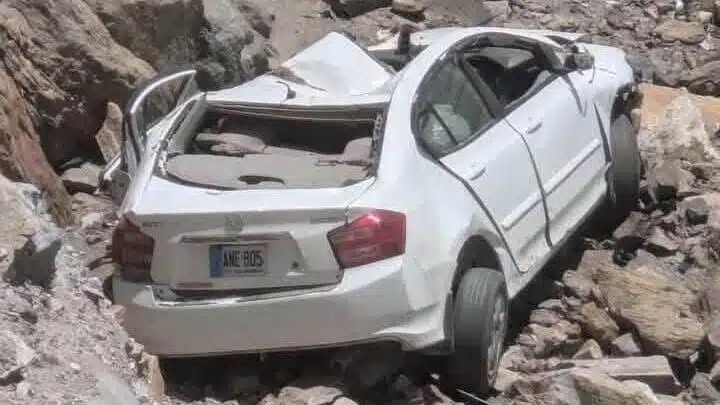
During the search in this area, rescue teams faced numerous difficulties. The lack of modern technology caused significant delays, and even mobile signals didn’t work in that region. After eight days of relentless efforts, on 23 May, the teams finally discovered the car in a deep ravine near Ganji Padi—a notoriously hazardous stretch of the Baltistan Highway. Despite the tough terrain, they recovered three bodies from inside the car and one from outside. You can see them in the picture below.

Gilgit-Skardu Road: A Dangerous Route
Gilgit-Skardu Road, i.e. S-1 Strategic Highway, is considered one of the most dangerous routes in Pakistan. This route runs along the Indus River and there are no guardrails in many places. Most of the places do not have mobile signal and whenever the weather is bad, landslides and accidents keep happening on this road, especially during the rainy season.
Need for improvement and prevention
This road has witnessed many accidents, and now the government must take action to find a solution. This accident has once again exposed the shortcomings of road safety and emergency response systems. The locals have been fed up with repeated strikes.
- Improve Infrastructure: Install guardrails and warning signs, and ensure communication is accessible throughout the entire route.
- Enhance Emergency Services: Equip rescue teams with modern tools and proper training. Deploying drones can greatly support search and rescue operations.
- Launch Awareness Campaigns: Educate tourists about the risks associated with mountainous regions to promote safer travel.
Ending Note
Wasif, Umar, Salman, and Usman set out with dreams of enjoying a memorable journey, but their journey ended in tragedy, leaving behind heavy hearts, unanswered questions, and lasting grief for their families and loved ones. Their story reminds us that every journey carries responsibility, and road safety should never be taken for granted.
While traveling, especially in remote and mountainous areas like Gilgit-Baltistan, drivers should remain extra cautious. Roads can be narrow, winding, steep, and unpredictable, while changing weather, landslides, loose gravel, and limited visibility can create additional risks. Drivers should maintain a safe speed, avoid dangerous overtaking, never drive when tired, and keep their full attention on the road. Seat belts should be used by everyone in the vehicle, and drivers should take regular breaks during long journeys.
Passengers also have a role to play. Avoid distracting the driver, encourage safe driving, and speak up when a driver is speeding or taking unnecessary risks. Travelers should also check weather and road conditions before leaving and keep essential emergency supplies and communication options available, particularly when traveling through remote areas.
Remembering Wasif, Umar, Salman, and Usman should encourage all of us to take road safety more seriously. Improving road conditions, emergency response, rescue services, and public awareness can help reduce the risks faced by travelers in remote regions.
Every safe journey means someone gets to return home to the people waiting for them. By driving carefully and responsibly, we can help protect someone’s young son, brother, husband, or father from becoming the next victim of a preventable road accident.




Comments are closed